Home » 2015 (Page 2)
Yearly Archives: 2015

Strategic Funding for Pest Management
Funding applications for state government pest management projects were recently approved for the Great Sandy National Park.

Tracking collars fitted to ‘high-risk’ Fraser Island dingoes in an effort to monitor their movements
The Queensland Parks and Wildlife Service has commenced a trial to track dingoes (that have shown aggressive behaviour) through the use of tracking and high visibility collars. (more…)
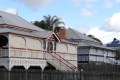
What have Maryborough Heritage Houses to do with FINIA?
FINIA and others concerned with preserving natural integrity can learn important lessons by examining why so many of the wonderful heritage houses of Maryborough have been preserved, restored and protected without any conservation orders applying to them.
I grew up in Maryborough and spent the first half of my life there. I still love the place. This once prosperous river port city for decades escaped the development and re-development boom that has transformed most other Queensland regional centres. The result was that Maryborough was left with the best assemblage of vernacular architecture in the form of its wonderful and unique old ‘Queenslander’ wooden houses. However, these are difficult and expensive to upkeep: paint and deteriorating wood is costly and difficult to replace and renew. Thus, during the 1950s to 1970s many were destroyed, replaced or modified.
In the mid-1980s, Maryborough’s locals began to appreciate the heritage value of these unique buildings. Despite modern homes costing less and usually being better designed functionally, people were willing to pay a premium to be the proud possessors of a heritage home, all extra expenses included. The result is the lavishing of love and care on hundreds of homes that can’t be taken to vintage car rallies or even placed in any competition.

Maryborough’s heritage houses have strong public appeal
Now these houses are being lovingly cared for and renovated in their original style. Some wrecks, far from being destroyed, have been painstakingly restored with a passionate pride. This has been accomplished without any legal status being given to the houses. The National Trust hasn’t listed them, and most have no other preservation orders placed on them.
Maryborough thus demonstrates the major benefit of people having a greater appreciation of unique heritage value. The zeal to preserve displayed here is an interesting phenomenon of developing community pride as a basis for the better management of our heritage. While this example relates to our built heritage, it can easily be extended to protecting our natural heritage. Recall that community proprietorial response made oil-drilling on the Great Barrier Reef unthinkable, and an Australia-wide sense of ownership stopped the Tasmanian Government destroying the Tasmanian wilderness to generate hydro-electricity. The more people who take pride in and value our heritage, be it Maryborough’s heritage houses or the natural integrity of a unique asset such as World Heritage Fraser Island (K’gari), the more ‘watchdogs’ there will be out to protect it.
For K’gari, if more people can be brought to appreciate the island’s natural values, this will increase the numbers prepared to act to preserve and/or restore its natural integrity. It boils down to a matter of pride. Thus, the greatest value of World Heritage status isn’t the additional legal layer of protection added by the Commonwealth assuming some responsibilities, but more particularly the layer of protection that comes from a public that recognises in the status the site’s unique heritage value.
One of FINIA’s challenges is to engender in the public a pride and passion for K’gari similar to that of Maryborough home owners for their heritage houses. A visitor centre where people can learn about K’gari’s natural values would go a long way towards achieving this. This explains why FIDO so passionately wants to see an impressive visitor centre created for Fraser Island and Great Sandy Strait sooner rather than later.
John Sinclair (AO), FIDO

Treatment of Planthopper on Pandanus
Over 8–11 June, members of the Lower Mary River Land and Catchment Care Group, Don Bradley, Lesley Bradley and Janet Price, treated 160 Pandanus plants at Kingfisher Bay Resort and Beach Front against infestation by Jamella australiae (Pandanus Planthopper). An effort was made to locate all plants at the resort.
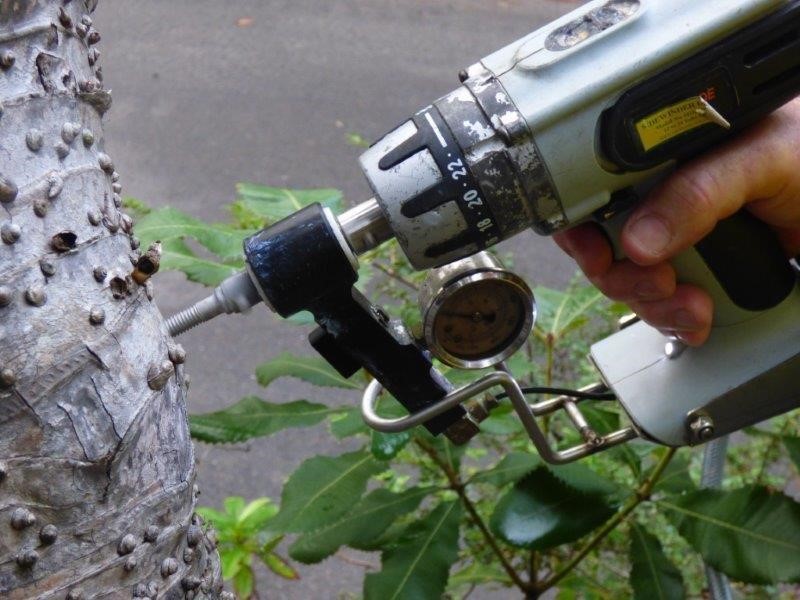
Injecting the chemical using the Sidewinder tool
In addition to the 160 plants treated, 25 plants were found to be infected with Jamella, including three in very poor condition; a further three dead plants were found. Treatment was with 50% Confidor, and involved injecting trunks and low braches, or in the case of smaller plants, spraying leaves and squirting the crowns. Size of tree and type of branching determined the number of injections per tree: trees head high received one injection; taller, single trunk trees received two injections; trees branching up high received three injections; and large trees branching received two injections per branch where branches could be reached. Infected trees were marked with blue paint.
Funding for this project was supplied by a BMRG-Chemical grant, and thanks go to QPWS for supplying the Sidewinder tool and training for the injections, and to Kingfisher Bay Resort for providing barge passes and accommodation.
Lesley Bradley, Lower Mary River Land and Catchment Care Group
Visitor Centres Vital to Public Natural History Appreciation
Because visitor centres play such an important role in elevating public appreciation and understanding of complex natural ecosystems, I have become a passionate advocate for having a world class visitor centre for Fraser Island. (more…)

Old Photos Revive Memories
Sue Sargent was instrumental in bringing FINIA collaborators together back in 2005 and along with the BMRG deserves credit for the creation of this wonderful collaboration. She continues to be FINIA’s chief inspirer and facilitator. (more…)
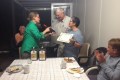
End of an Era…
John Sinclair and Su Dawson from Fraser Island Defenders Organisation (FIDO) hosted their last weeding trip to Eurong as group leaders in May this year. This was quite a momentous occasion as John has been leading groups of volunteers to carry out weed work on Fraser Island for over 10 years.
Under the stewardship of John and Su, one aspect of the Eurong project has been to demonstrate to landholders the positive attractions of growing only natives and replacing exotic species. This is done mainly through demonstration gardens at the Eurong Resort, from which many of the worst weeds originated.
Another facet has been dealing with the weeds that have escaped from the gardens and invaded the surrounding bush. The project has given higher priority to the larger weeds, such as lantana, Easter Cassia and Brazilian Cherries, due to their potential to have the greatest ecological impact on the forest. However, while there has been notable success in reducing and almost completely eliminating these in the urban area, other weeds have now become a higher priority because their windblown seeds have been dispersed much further than previously known. These weeds are now well established outside the dingo fence and tracking them down will be a challenge for the future.
FIDO’s project also engages volunteers in the monitoring of the natural integrity of Fraser Island. A project to assess the environmental impacts of sediments being washed off the roads is now being developed and refined in collaboration with the University of the Sunshine Coast.
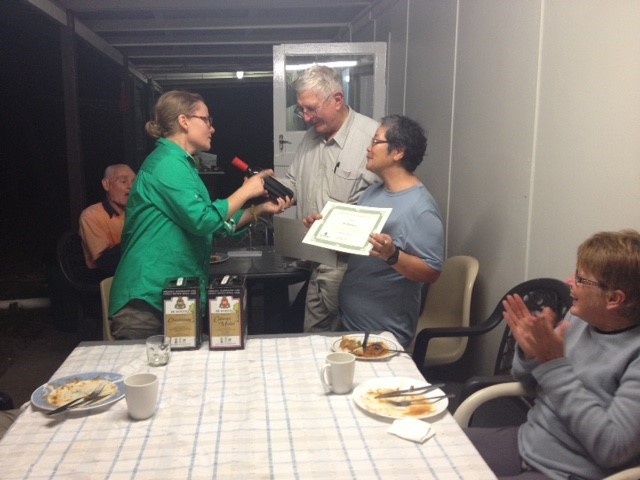
John and Sue receiving their certificate of appreciation, and a nice bottle of Shiraz
John and Su will continue to be involved in maintaining the natural integrity of Fraser Island, however Maree Prior from Cooloola Coastcare will be taking the central role in leading the groups of volunteers in the future.
Thank you to John and Su for your tireless contribution over many years.
Kath Nash, BMRG
AJEM Special Issue, ‘Future of an icon’, now available!
In our last FINIA newsletter, we introduced a new paper on Fraser Island, published by the Australian Journal of Environmental Management (AJEM). This paper was one of eight comprising a then-forthcoming special issue: Future of an Icon: K’gari-Fraser Island, climate change and social expectations. This special issue is now out! (more…)
FINIA is turning TEN
When FINIA was founded in December 2005, the catalyst was a two-day gathering of a large number of groups and agencies at Dilli Village, Fraser Island, organised by the Burnett Mary Regional Group. Nobody then could have imagined that an organisation that has a set of objectives but no formal constitution, and therefore no formal membership, could have survived for so long and achieved so much just through communication and collaboration. (more…)

Managing Values other than Outstanding Universal Value on Fraser Island World Heritage Area
Adapted from Ross 2014 – K’gari Values
Fraser Island World Heritage Area is recognised for geological and geomorphic values of island formation and for biological processes relating to rainforest succession on high dunes. World Heritage Area listing did not extend to Aboriginal heritage significance, despite the acknowledged tangible and intangible cultural values of Fraser Island (known to Butchulla Traditional Owners as K’gari) in the form of campsites, scarred trees, shell middens, story places and the Indigenous knowledge of landscape and species management. Nevertheless, management of K’gari can and does take Butchulla knowledge into account.
The Fraser Island World Heritage Area managers are formally advised by three Advisory Committees: the Fraser Island World Heritage Area Scientific Advisory Committee (SAC), the Community Advisory Committee (CAC) and the Indigenous Advisory Committee (IAC). These committees help ensure that a range of values, including Aboriginal heritage values, are reviewed, and where deemed appropriate, taken into account by managers. For example, in 2014, Butchulla concerns regarding the proposed management of Takky Wooroo (Indian Head) were aired at a combined Advisory Committee meeting, and managers responded by agreeing to seek further information from Butchulla knowledge holders before proceeding with planning proposals.

The input of Butchulla knowledge holders is contributing to the management of Takky Wooroo (Indian Head)
The three Advisory Committees thus have an opportunity to ensure that the full range of values of K’gari are considered for incorporation into management planning for this World Heritage place, despite the formal limitations of listing. It is imperative that the Advisory Committees are continued into the future, with appropriate levels of government funding and support.
Anne Ross
Anne Ross’s full article, ‘Managing Values Other than Outstanding Universal Value—A case study from K’gari (Fraser Island World Heritage Area), Queensland, Australia’, originally published in Historic Environment, 26(2), 2014, can be found here: Ross 2014 – K’gari Values (pdf)
 FINIA
FINIA 