Home » Fraser Island Defenders Organisation (Page 11)
Category Archives: Fraser Island Defenders Organisation

In Search of the Elusive Ground Parrot
Queensland Parks and Wildlife Service rangers on K’gari (Fraser Island) recently deployed five Bio-acoustic remote listening posts purchased by FIDO (Fraser Island Defenders organisation) in swamp/heath areas across the island. These devices allow for scheduled activation times, making surveys for species with distinct calls, such as frogs and birds, easier.
(more…)
Fraser Island (Kgari)’s Wildlife Status
It is vital that we start to gain better hard data on K’Gari’s natural resources, particularly its wildlife, to have a better picture of its natural health. This is the underlying rationale for FIDO’s initiative in sponsoring the BioBlitz based at Dilli Village from 28 November to 4 December.
John Sinclair has been visiting Fraser Island (Kgari) for more than 60 years. During that time, based on his observations, he is convinced that the populations of many once common species have declined: fish, black swans, pied oystercatchers, pipits, honeyeaters, and many other birds have declined; seeing ghost crabs is now a rarity; snake populations have plummeted; as have frogs as their place is usurped by cane toads. There is firm evidence of the decline of dugongs and the extirpation of some wildlife, such as quolls.

Collaboration in Action
The collaboration between the University of the Sunshine Coast and the Fraser Island Defenders Organisation (FIDO) developed further recently when FIDO made a $100,000 donation to the USC on 1 September to fund research into minimising the impact of vehicle traffic on the fragile natural environment of Fraser Island. The collaboration has grown over recent years from the USC sponsorship of the biennial Fraser Island conferences organized by FIDO and the forthcoming BioBlitz, to assisting the development of the Fraser Island Repository at Sippy Downs and other projects. (more…)
Eurong Nursery Gives Bush Regeneration a Boost
FIDO’s July bush regeneration working bee planted more than 100 new native plants in the Eurong Resort grounds and village. While more than 20 of these plants came from the Kingfisher nursery on the western side of the island, the project wouldn’t have been possible without the rejuvenation of the QPWS eastern Eurong nursery. The availability of a functioning nursery to meet the demands of residents and bush regenerators has challenged FINIA since its founding in 2005.


BioBlitz Bonus!
The BioBlitz has attracted interest from an unexpected quarter. The Fraser Coast RATs (Regional Artists and Tutors) are are keen to cover the BioBlitz as a community-based arts projects, A representative of the group describes their plans: “Members of this award winning contemporary artists group have multi discipline art practices and a common goal to engage the public with regionally based arts projects. We work closely with Fraser Coast community organisations on projects as diverse as ‘Art in empty shopfronts’ to community Street Art commissioned by Fraser Coast Council.”
Fraser Island to be BioBlitzed by Scientists
Led by FIDO, a huge Fraser Island (K’Gari) BioBlitz from 28 November to 4 December will bring together experts from many areas of biology to carry out a stocktake of the natural resources of the World Heritage island.
Based at the Dilli Village Fraser Island Research and Learning Centre, the BioBlitz is being well supported by the University of the Sunshine Coast, the Queensland Parks and Wildlife Service and FINIA.
The study area extends from the ocean beach to Lake Birrabeen, covering all six dune systems and encompassing most ecosystem types from heathlands, tall forests, swamps, fens and perched dune lakes except for the estuarine environments. It is hoped to achieve more by maintaining a tight and intense focus on this particular study area rather than an island wide hunt.
The study area is very accessible with a number of tracks through it that will allow scientists to easily access representative places of interest.

Sustainable Transport Study for Fraser Island (K’Gari)
For almost a year, FIDO and QPWS were at an impasse over FIDO’s proposal to fund a feasibility study into the building of a light rail from Kingfisher Resort to Eurong. The QPWS saw four major impediments to them supporting such a study, while FIDO remained alarmed at the down-cutting of the fragile sand roads, with the scoured out sediment ending up in other locations.
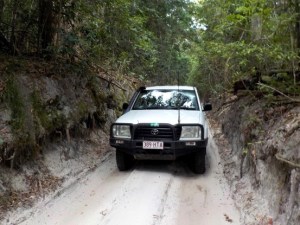
Down-cutting along 0.5 km of Woralie Track between the eastern edge of the rainforest and the turnoff to Lake Allom has carved a canyon 2 m deep. Thousands of tonnes of sand have been relocated downslope from these cuttings
FIDO estimates that, on average, every visitor to Fraser Island travelling by any form of 4WD (including buses) is responsible for stirring up more than a tonne of sand that will be scoured downslope when it rains. Some of this ends up in Fraser Island’s precious lakes. FIDO has long been calling for a stop to the unnecessary stirring up of surface sand and, for 42 years, has been advocating a light rail alternative to 4WDs.
A meeting with Environment Minister Steven Miles on 11 April helped to resolve the stalemate between FIDO and QPWS. It was resolved that the environmental impact of road down-cutting on K’gari needs to be urgently addressed. The agreed outcome was that FIDO will commission and pay for an independent ‘Sustainable Transport Options for Fraser Island (K’Gari)’ study. This study will explore all options, including light rail, to reduce the current environmental impact of visitation.
In 2002, a study by Gutteridge Haskins & Davey Pty Ltd (GHD) on K’Gari found:
- Moderate severity smothering: 6% of road network
- Moderate down-cutting: 7% of road network
- High-severity siltation: 8 sites
- Cultural heritage site: 1 site impacted by roads
- High-severity smothering: 1% of road network
- Severe down-cutting: 2% of road network
- Moderate severity siltation: 12 sites
Using money from the Barbara Winkley bequest that FIDO anticipates to receive in the near future, FIDO will seek to revive the GHD study commissioned in 2000 by the QPWS that was halted prematurely in 2002 just as it was nearing a critical conclusion. The now proposed study will, among other things, update the 2002 information to determine how the state of K’Gari’s roads has changed in 15 years.
John Sinclair (AO), FIDO
Fighting Triffids
Peter Shooter continues to lead his teams of FIDO volunteers in their never-ending war against the very aggressive and invasive African subspecies of Abrus prectorius.
(more…)
A BioBlitz for Fraser Island
A BioBlitz on Fraser Island (K’gari) has moved a few steps closer to reality with FIDO setting the proposed dates for the Blitz as 28 November – 4 December 2016. However, before FIDO can launch the promotion for the BioBlitz, which is supported by FINIA, the University of the Sunshine Coast (USC) and the Queensland Parks and Wildlife Service, supplementary funding is required to engage a coordinator to liaise with scientists and other participants and retrieve the vital data collected. At this stage, FIDO is only issuing advance warning to alert people to the proposed BioBlitz event: Beach to Boomanjin and Birrabeen.
Details of Beach to Boomanjin and Birrabeen
Fraser Island (K’Gari) is inscribed on the World Heritage list because of its biological, geomorphological and aesthetic values; however, much more biological research is needed to know the extent of K’gari’s natural resources, with a BioBlitz of a discrete part of Fraser Island standing to add greatly to the ecological understanding of this site.
The BioBlitz, which is to be based at Dilli Village, aims to bring together teams of entomologists, botanists, ornithologists, zoologists, herpetologists and other specialist groups (fishes, fungi, etc.) to scour the study area. Each team will develop its own program and modus operandi. It is expected that the team leader will be responsible for compiling a report of the team’s findings to add to the existing data banks being built at USC.
FIDO is seeking to appoint a coordinator before this project can proceed. The coordinator will recruit specialist scientists from a range of disciplines to study the defined research area, which covers a diversity of habitats, to develop an inventory of the natural resources and species within that area. FIDO will also recruit volunteers as necessary to assist scientists and specialists logistically.
The study area includes samples of all six dune systems, including Dune System 4 east of Lake Birrabeen and Dune Systems 5 and 6 in the vicinity of the Boomanjin airstrip. In addition, the area includes three large perched dune lakes, two creeks and a number of old swamps, as well as various forest types. It will be a broad transect of a wide range of ecotypes, from the beach through the foredunes and the freshwater aquatic environments of Govi and Gerrawea Creeks. It will also enable comparison between mined and unmined areas in both the foredune and hind dune areas. It will include the large peat swamp, with its flarks and fens, never before studied in detail.
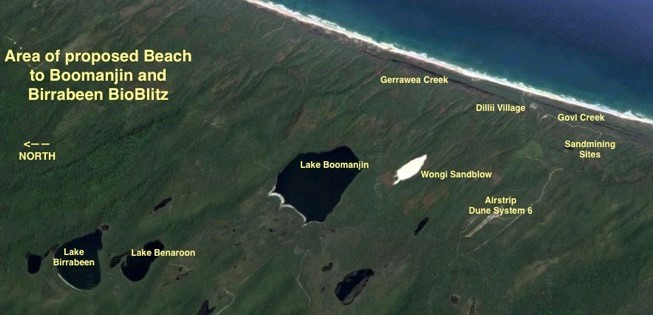
The proposed study area will include a diverse range of ecotypes, including all 6 dune system types
Dilli Village has accommodation for up to 60 people, as well as a large camping area and 24-hour 240V power, which may be needed for some equipment. It also has a large meeting area. There will be opportunities at Dilli Village each night for the various teams to compare notes and share observations of their field work.
John Sinclair (AO), FIDO

Work Continues on George Haddock Track
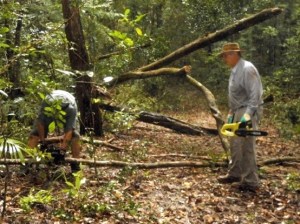
Track clearing was done manually, with little assistance other than from battery-operated chainsaws to deal with larger tree-falls across the track
Over the 2016 Easter weekend, 16 volunteers helped to honour FIDO’s obligation to maintain the George Haddock Track. The team cleared 17 km of track of fallen timber and major regrowth. During 2014, FIDO and National Parks Association of Queensland volunteers cleared 22.7 km of walking tracks along former logging tracks and roads in nine different sections of the 52 km George Haddock Track, supported by a Friends of Parks grant. No maintenance had been done since October 2013, except for a little clearing between Lake Coomboo and Hidden Lake.
During these latest clearing efforts, the swathe of cleared ground around the Harold Charles Barracks was greatly extended by stripping away regrowth and accumulated fallen debris. This will provide critical infrastructure with a greater safety margin from potential fires. It also created a larger flat area for campers participating in future working bees.
John Sinclair (AO), FIDO
 FINIA
FINIA 