Home » QPWS (Page 10)
Category Archives: QPWS
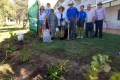
A little landscaping improves the natural integrity
Back in 2011, FINIA had a dilemma about how to use the nursery-raised plants using island genetic stock that needed planting out. It was resolved to plant them at the western entrance to Eurong as a demonstration garden. (more…)

Mibir (turtle) nesting and hatching on K’gari
Marine turtle season is coming to an end. The adult courting males and nesting females have returned to their home areas from hundreds of kilometres abroad, and hatchlings are emerging from their underground incubation period to embark on their life journey. Only 1 in 1000 make it to maturity, around 35–50 years old.
North Fraser Island (K’gari) has a small turtle rookery with a seasonal night driving curfew, where green turtles (Chelonia mydas) and loggerhead turtles (Caretta caretta) court and breed, and females deposit their precious cargo of eggs into the dunes before leaving the young to their fate. These eggs (over 70%) also provide seasonal food resources for wildlife, including dingoes. (more…)
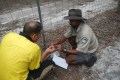
Firebreak Upgrades – a Critical Interface Zone
A state-wide ‘I-zone’ initiative for the protection of ‘at risk’ private infrastructure on boundary interfaces with QPWS tenure provided funding for a review of the current firebreaks on Fraser Island (K’gari).
(more…)Fraser Island Fauna Survey
Since departing Fraser Island 16 years ago, it was great to get back there earlier this year to renew acquaintanceships with old friends and make some new ones. I was over to assist a good friend and retired herpetologist, Harald Ehmann, to look for the endangered Fraser Island endemic, the Fraser Island Sand Skink Coggeria naufragus. I was on the island from the 8-13 February this year and Harald three days longer.
Eurong Nursery Gives Bush Regeneration a Boost
FIDO’s July bush regeneration working bee planted more than 100 new native plants in the Eurong Resort grounds and village. While more than 20 of these plants came from the Kingfisher nursery on the western side of the island, the project wouldn’t have been possible without the rejuvenation of the QPWS eastern Eurong nursery. The availability of a functioning nursery to meet the demands of residents and bush regenerators has challenged FINIA since its founding in 2005.


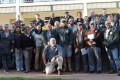
Working with the Mob
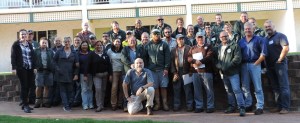
Participants of the Working with the Mob training program held in June 2016
Over two days in June, Queensland Parks and Wildlife Service (QPWS) staff and representatives of the Butchulla Traditional Owners, came together on K’gari to participate in the training program Working with the Mob.
The QPWS Partnerships Team developed the Working with the Mob training program to support its commitment to enhancing cultural competency within the agency. The time together was a great opportunity for QPWS employees to engage with the Butchulla people through an appreciation of history, tradition, culture and respect.
The training offered opportunities to break into informal groups led by Butchulla representatives. These sessions provided an excellent opportunity to learn more about the local Traditional Owners’ protocols, beliefs and values. Other training sessions included topics such as native title, indigenous cultural heritage and developing good working relationships.
Ross Belcher, Principal Ranger, Fraser Coast Area, QPWS shared some of his reflections after the training program:
“It was a pleasure to take part in this initiative on K’gari, which has made a major contribution to maintaining and building on the relationship between the Butchulla Traditional Owners and QPWS. My impression is that the Butchulla people have a strong desire to engage with the current land managers (QPWS staff) to pass on traditional values, stories and aspirations and to build a strong and respectful working relationship. The QPWS staff demonstrate a strong desire to understand the Butchulla story and to positively engage with and contribute to our cooperative relationship. We certainly have people with feet in both camps, Butchulla and other indigenous people employed by QPWS are making an outstanding contribution to K’gari, hopefully we can build the numbers up in good time. Good progress has been made in our collaboration in the management of K’gari, and I hope that in future the Butchulla people will be taking the lead in developing and coordinating more opportunities for sharing of stories and aspirations, and we will be working as one mob protecting the natural and cultural values of K’gari and surrounding Butchulla land and sea. Looking forward to the next meeting ”
Contributed by Moyra McRae, Queensland Parks and Wildlife Service, Maryborough
A BioBlitz for Fraser Island
A BioBlitz on Fraser Island (K’gari) has moved a few steps closer to reality with FIDO setting the proposed dates for the Blitz as 28 November – 4 December 2016. However, before FIDO can launch the promotion for the BioBlitz, which is supported by FINIA, the University of the Sunshine Coast (USC) and the Queensland Parks and Wildlife Service, supplementary funding is required to engage a coordinator to liaise with scientists and other participants and retrieve the vital data collected. At this stage, FIDO is only issuing advance warning to alert people to the proposed BioBlitz event: Beach to Boomanjin and Birrabeen.
Details of Beach to Boomanjin and Birrabeen
Fraser Island (K’Gari) is inscribed on the World Heritage list because of its biological, geomorphological and aesthetic values; however, much more biological research is needed to know the extent of K’gari’s natural resources, with a BioBlitz of a discrete part of Fraser Island standing to add greatly to the ecological understanding of this site.
The BioBlitz, which is to be based at Dilli Village, aims to bring together teams of entomologists, botanists, ornithologists, zoologists, herpetologists and other specialist groups (fishes, fungi, etc.) to scour the study area. Each team will develop its own program and modus operandi. It is expected that the team leader will be responsible for compiling a report of the team’s findings to add to the existing data banks being built at USC.
FIDO is seeking to appoint a coordinator before this project can proceed. The coordinator will recruit specialist scientists from a range of disciplines to study the defined research area, which covers a diversity of habitats, to develop an inventory of the natural resources and species within that area. FIDO will also recruit volunteers as necessary to assist scientists and specialists logistically.
The study area includes samples of all six dune systems, including Dune System 4 east of Lake Birrabeen and Dune Systems 5 and 6 in the vicinity of the Boomanjin airstrip. In addition, the area includes three large perched dune lakes, two creeks and a number of old swamps, as well as various forest types. It will be a broad transect of a wide range of ecotypes, from the beach through the foredunes and the freshwater aquatic environments of Govi and Gerrawea Creeks. It will also enable comparison between mined and unmined areas in both the foredune and hind dune areas. It will include the large peat swamp, with its flarks and fens, never before studied in detail.
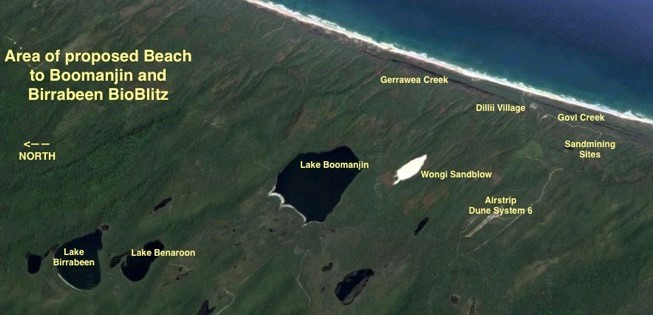
The proposed study area will include a diverse range of ecotypes, including all 6 dune system types
Dilli Village has accommodation for up to 60 people, as well as a large camping area and 24-hour 240V power, which may be needed for some equipment. It also has a large meeting area. There will be opportunities at Dilli Village each night for the various teams to compare notes and share observations of their field work.
John Sinclair (AO), FIDO
Sisal Stripped to Bare Minimum
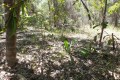
Originally from Mexico, Sisal Hemp plants grow up to two metres tall and closely resemble the native Crinium lily. As the plant matures, it produces a tall flowering spike on which smaller plants develop. Mature plants are often surrounded by younger plants that have fallen off the flowering spike. These younger plants are easily spread through site disturbance, which can roll or wash them down slopes, where they establish new colonies.
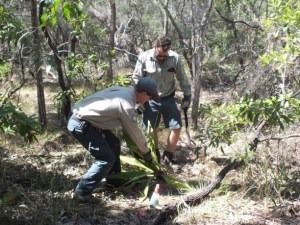
QPWS staff at work removing immature sisal
Queensland Parks and Wildlife rangers have worked to remove large patches of Sisal Hemp from land surrounding Bogimbah, Urang and Wanggoolba creeks since 2002. Contractors funded through the State Government’s strategic pest management program have also assisted staff in controlling these Sisal Hemp infestations by removing remaining plants before they reach maturity and surveying areas for potential infestations.
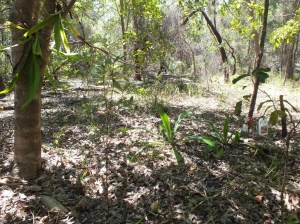
Immature sisal 2015
In the first four years, the area affected by Sisal Hemp was reduced from an approximately 3,000 square metre area, to just small sporadic re-emergences of plants. Sisal Hemp was initially introduced to Fraser Island in the 1800s, in an effort to cover the site of the Bogimbah Mission; now, native grasses and shrubs cover this important cultural site.
Help reduce the spread of introduced species by always disposing of garden waste at designated waste transfer stations. Weeds know no boundaries and management is everyone’s responsibility.
L. Behrendorff RIC NRM, Queensland Parks & Wildlife Service
Tiny Wasp Released to Save Fraser Island’s Pandanus
In an effort to rescue Fraser Island’s pandanus trees from the devastating effects of infestation by Jamella leaf-hopper (Jamella australiae), 26 October saw the long-awaited release around Eurong of a tiny sandfly-sized predatory wasp (Aphanomerus sp.) that is expected to help to check Jamella numbers. (more…)

Strategic Funding for Pest Management
Funding applications for state government pest management projects were recently approved for the Great Sandy National Park.
 FINIA
FINIA 