Home » Volunteers (Page 10)
Category Archives: Volunteers
Fighting Triffids
Peter Shooter continues to lead his teams of FIDO volunteers in their never-ending war against the very aggressive and invasive African subspecies of Abrus prectorius.
(more…)
A BioBlitz for Fraser Island
A BioBlitz on Fraser Island (K’gari) has moved a few steps closer to reality with FIDO setting the proposed dates for the Blitz as 28 November – 4 December 2016. However, before FIDO can launch the promotion for the BioBlitz, which is supported by FINIA, the University of the Sunshine Coast (USC) and the Queensland Parks and Wildlife Service, supplementary funding is required to engage a coordinator to liaise with scientists and other participants and retrieve the vital data collected. At this stage, FIDO is only issuing advance warning to alert people to the proposed BioBlitz event: Beach to Boomanjin and Birrabeen.
Details of Beach to Boomanjin and Birrabeen
Fraser Island (K’Gari) is inscribed on the World Heritage list because of its biological, geomorphological and aesthetic values; however, much more biological research is needed to know the extent of K’gari’s natural resources, with a BioBlitz of a discrete part of Fraser Island standing to add greatly to the ecological understanding of this site.
The BioBlitz, which is to be based at Dilli Village, aims to bring together teams of entomologists, botanists, ornithologists, zoologists, herpetologists and other specialist groups (fishes, fungi, etc.) to scour the study area. Each team will develop its own program and modus operandi. It is expected that the team leader will be responsible for compiling a report of the team’s findings to add to the existing data banks being built at USC.
FIDO is seeking to appoint a coordinator before this project can proceed. The coordinator will recruit specialist scientists from a range of disciplines to study the defined research area, which covers a diversity of habitats, to develop an inventory of the natural resources and species within that area. FIDO will also recruit volunteers as necessary to assist scientists and specialists logistically.
The study area includes samples of all six dune systems, including Dune System 4 east of Lake Birrabeen and Dune Systems 5 and 6 in the vicinity of the Boomanjin airstrip. In addition, the area includes three large perched dune lakes, two creeks and a number of old swamps, as well as various forest types. It will be a broad transect of a wide range of ecotypes, from the beach through the foredunes and the freshwater aquatic environments of Govi and Gerrawea Creeks. It will also enable comparison between mined and unmined areas in both the foredune and hind dune areas. It will include the large peat swamp, with its flarks and fens, never before studied in detail.
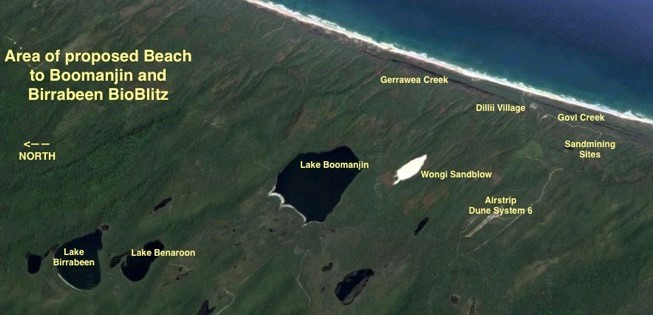
The proposed study area will include a diverse range of ecotypes, including all 6 dune system types
Dilli Village has accommodation for up to 60 people, as well as a large camping area and 24-hour 240V power, which may be needed for some equipment. It also has a large meeting area. There will be opportunities at Dilli Village each night for the various teams to compare notes and share observations of their field work.
John Sinclair (AO), FIDO

Green Army Battles for K’Gari’s Natural Integrity
Work is underway in Fraser Island World Heritage area by the first 9-person Green Army team, which includes three young Butchulla men. Despite encountering hold-ups in gaining approval for overnight residence on the island, as well as delays in beginning training, the Green Army team is being kept busy with the important tasks of removing rubbish, lantana, groundsel and other weeds from the main entry road near the Wanggoolba ferry landing, and lantana control in Dundubara creek.
As they return each week as part of their six-month program, every member of the team is gaining a greater familiarity with Fraser Island (K’gari) and personally benefitting from the training and experience they are receiving. As part of their work, the Green Army team has received training in safe chemical use, as well as fencing construction and deconstruction. They have been using these new skills to contribute to K’gari’s natural integrity.
It is hoped that as the program progresses, the productivity of future teams will benefit from overcoming the challenges that any new partnership arrangement must face (especially for an area as significant as the Fraser Island World Heritage Area). In this way, we hope that the CVA Green Army teams will be an ongoing presence on Fraser Island and will be able to make an even greater contribution to weed and erosion control in some very critical areas of K’Gari.

Work Continues on George Haddock Track
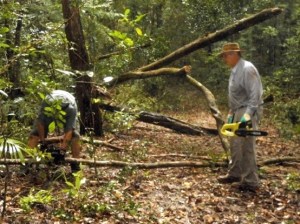
Track clearing was done manually, with little assistance other than from battery-operated chainsaws to deal with larger tree-falls across the track
Over the 2016 Easter weekend, 16 volunteers helped to honour FIDO’s obligation to maintain the George Haddock Track. The team cleared 17 km of track of fallen timber and major regrowth. During 2014, FIDO and National Parks Association of Queensland volunteers cleared 22.7 km of walking tracks along former logging tracks and roads in nine different sections of the 52 km George Haddock Track, supported by a Friends of Parks grant. No maintenance had been done since October 2013, except for a little clearing between Lake Coomboo and Hidden Lake.
During these latest clearing efforts, the swathe of cleared ground around the Harold Charles Barracks was greatly extended by stripping away regrowth and accumulated fallen debris. This will provide critical infrastructure with a greater safety margin from potential fires. It also created a larger flat area for campers participating in future working bees.
John Sinclair (AO), FIDO

Call for Volunteers to work on K’gari, Second Half 2016
FIDO has been conducting week-long working bees to tackle the urban weeds of Fraser Island for more than a decade. With support of other organizations aiming to improve the natural integrity, FIDO is determined to bring the urban weeds in the townships of Eurong and Happy Valley under control. (more…)

Fraser Island to Benefit from Commonwealth Funding for Green Army Projects
The Fraser Island Defenders Organization has been provided with funding as Project Host as a result of Green Army funding for two projects from the Department of Environment and Heritage. The service provider for these projects will be Conservation Volunteers Australia.
The project, Restoring the balance in weed and erosion management on Fraser Island, will commence in late February and again in mid-August and run for 20 weeks. The six participants will range from 17 to 24 years old, and will be provided with training, including Occupational Health and Safety, First Aid, chemical use and the management of small motors. They will gain hands on skills in weed management, erosion control and will be fortunate to have advice and information from the QPWS rangers who will direct the work plan.
The participants will have their training at Hervey Bay and spend four days a week on Fraser Island working on different parts of the island. Other potential work may include:
- Easter Cassia management around Happy Valley and south to Yidney scrub
- Jamella – egg raft collection (and wasp release if training were provided), monitoring and leaf stripping
- Giant Rat’s Tail Grass control
- Eurong nursery – plant propagation and re-potting, including of Pandanus
- Great Walk track maintenance
- Track building
- Site stabilisation through erosion control and weed management on Indian Head (Takky Wooroo).
The project provides a unique opportunity to have work carried out on Fraser Island over the period of a year that would possibly take many years otherwise.
The team will work with a number of different groups on the island, including the Butchulla people, to learn about the culture and management of the island.
Libby Gardiner, Regional Manager Southern Queensland, CVA

Treatment of Planthopper on Pandanus
Over 8–11 June, members of the Lower Mary River Land and Catchment Care Group, Don Bradley, Lesley Bradley and Janet Price, treated 160 Pandanus plants at Kingfisher Bay Resort and Beach Front against infestation by Jamella australiae (Pandanus Planthopper). An effort was made to locate all plants at the resort.
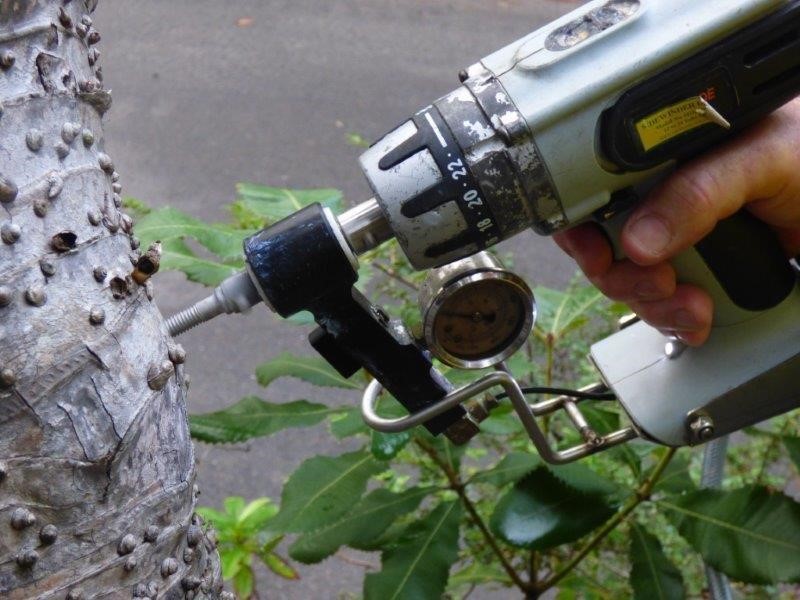
Injecting the chemical using the Sidewinder tool
In addition to the 160 plants treated, 25 plants were found to be infected with Jamella, including three in very poor condition; a further three dead plants were found. Treatment was with 50% Confidor, and involved injecting trunks and low braches, or in the case of smaller plants, spraying leaves and squirting the crowns. Size of tree and type of branching determined the number of injections per tree: trees head high received one injection; taller, single trunk trees received two injections; trees branching up high received three injections; and large trees branching received two injections per branch where branches could be reached. Infected trees were marked with blue paint.
Funding for this project was supplied by a BMRG-Chemical grant, and thanks go to QPWS for supplying the Sidewinder tool and training for the injections, and to Kingfisher Bay Resort for providing barge passes and accommodation.
Lesley Bradley, Lower Mary River Land and Catchment Care Group

Old Photos Revive Memories
Sue Sargent was instrumental in bringing FINIA collaborators together back in 2005 and along with the BMRG deserves credit for the creation of this wonderful collaboration. She continues to be FINIA’s chief inspirer and facilitator. (more…)
End of an Era…
John Sinclair and Su Dawson from Fraser Island Defenders Organisation (FIDO) hosted their last weeding trip to Eurong as group leaders in May this year. This was quite a momentous occasion as John has been leading groups of volunteers to carry out weed work on Fraser Island for over 10 years.
Under the stewardship of John and Su, one aspect of the Eurong project has been to demonstrate to landholders the positive attractions of growing only natives and replacing exotic species. This is done mainly through demonstration gardens at the Eurong Resort, from which many of the worst weeds originated.
Another facet has been dealing with the weeds that have escaped from the gardens and invaded the surrounding bush. The project has given higher priority to the larger weeds, such as lantana, Easter Cassia and Brazilian Cherries, due to their potential to have the greatest ecological impact on the forest. However, while there has been notable success in reducing and almost completely eliminating these in the urban area, other weeds have now become a higher priority because their windblown seeds have been dispersed much further than previously known. These weeds are now well established outside the dingo fence and tracking them down will be a challenge for the future.
FIDO’s project also engages volunteers in the monitoring of the natural integrity of Fraser Island. A project to assess the environmental impacts of sediments being washed off the roads is now being developed and refined in collaboration with the University of the Sunshine Coast.
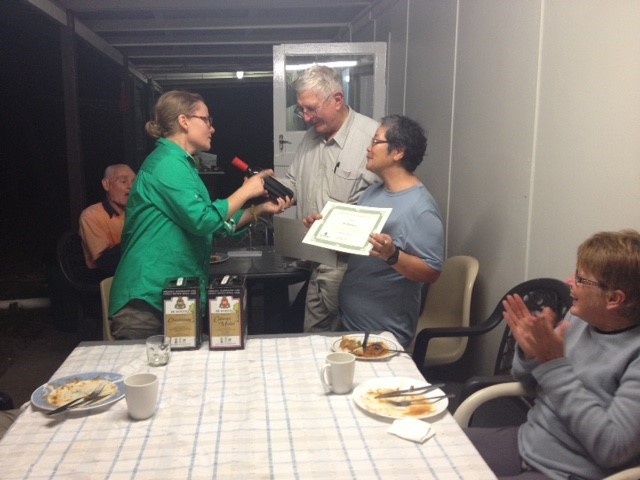
John and Sue receiving their certificate of appreciation, and a nice bottle of Shiraz
John and Su will continue to be involved in maintaining the natural integrity of Fraser Island, however Maree Prior from Cooloola Coastcare will be taking the central role in leading the groups of volunteers in the future.
Thank you to John and Su for your tireless contribution over many years.
Kath Nash, BMRG
FIDO’s Bush Regeneration Program
FIDO held six weeding weeks on Fraser Island in 2015, three working on Eurong bush regeneration and three in Happy Valley with a heavy focus on controlling the Abrus infestation there. This year FIDO is making some transitional changes to its weeding and bush regeneration programs as some of the older players, including John Sinclair and Su Dawson, withdraw to a less active role and pass the leadership on to others. (more…)
 FINIA
FINIA 