Home » Fraser Island Defenders Organisation (Page 12)
Category Archives: Fraser Island Defenders Organisation

Call for Volunteers to work on K’gari, Second Half 2016
FIDO has been conducting week-long working bees to tackle the urban weeds of Fraser Island for more than a decade. With support of other organizations aiming to improve the natural integrity, FIDO is determined to bring the urban weeds in the townships of Eurong and Happy Valley under control. (more…)

Fraser Island to Benefit from Commonwealth Funding for Green Army Projects
The Fraser Island Defenders Organization has been provided with funding as Project Host as a result of Green Army funding for two projects from the Department of Environment and Heritage. The service provider for these projects will be Conservation Volunteers Australia.
The project, Restoring the balance in weed and erosion management on Fraser Island, will commence in late February and again in mid-August and run for 20 weeks. The six participants will range from 17 to 24 years old, and will be provided with training, including Occupational Health and Safety, First Aid, chemical use and the management of small motors. They will gain hands on skills in weed management, erosion control and will be fortunate to have advice and information from the QPWS rangers who will direct the work plan.
The participants will have their training at Hervey Bay and spend four days a week on Fraser Island working on different parts of the island. Other potential work may include:
- Easter Cassia management around Happy Valley and south to Yidney scrub
- Jamella – egg raft collection (and wasp release if training were provided), monitoring and leaf stripping
- Giant Rat’s Tail Grass control
- Eurong nursery – plant propagation and re-potting, including of Pandanus
- Great Walk track maintenance
- Track building
- Site stabilisation through erosion control and weed management on Indian Head (Takky Wooroo).
The project provides a unique opportunity to have work carried out on Fraser Island over the period of a year that would possibly take many years otherwise.
The team will work with a number of different groups on the island, including the Butchulla people, to learn about the culture and management of the island.
Libby Gardiner, Regional Manager Southern Queensland, CVA
Propagating Natives instead of Weeds
Since Fraser Island’s World Heritage nomination was prepared 25 years ago, the number of identified weeds has grown from 40 to 200. Most of the additions to the weed list are garden escapees or alien grasses and pasture plants.
Most of these alien grasses and pasture plants have arrived on K’Gari as hitchhiking seeds stuck in the under-bodies of vehicles that haven’t been cleaned adequately before going to the island, or in the luggage and freight brought inside those vehicles by island visitors. This is evident by the fact that the epicentres for the invasion of almost all of the grasses and pasture plants, such as Green Panic and Siratro, are in the township or camping reserves. By diligence, we are whittling away at these weeds that arrived essentially as stowaways.
A more difficult challenge is countering the weeds that were deliberately taken to Fraser Island as garden plants. Landholders sought to establish hardy plants that could thrive on the island with little care or attention when they were absent for long periods. Thus they came up with a group of plants that were ideal to survive if they got loose in the Fraser Island bush. Roses and many of the more classic garden plants just can’t survive on Fraser Island. However, garden plants like Clivias, Coral Creeper, Singapore Daisy, Easter Cassia, Mother-in-Law’s Tongues, Glory Lily, Mother of Millions and Fish-bone Ferns, which looked attractive around the houses and required little care, all escaped their garden enclosures and ran riot on the island. Because these plants are so hardy they are now very difficult to eradicate.

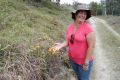
Coolum-based volunteer, Suzanne Wilson, gathering seed for the Eurong QPWS nursery. These are attractive plants that can be grown by Fraser Island landholders
Landholders are being encouraged to plant and cultivate attractive native plants. However, sourcing those plants has been a major problem. The Queensland Parks and Wildlife Service has a nursery, but lacks the staff to operate it as a supplier of plants on demand to landholders who are told not to take any plants at all onto the island.
Now, as another FINIA collaboration, FIDO and the Fraser Island Association are building up a stock of plants to entice landholders to opt to grow natives that are grown from seed collected on the island, and which, with a little tender loving care to establish them, can do just as well as the weeds we are working to eliminate. As well as purchasing pots and other nursery supplies, FIDO has been scrounging cleaned used pots and recruited a very experienced seed collector to help build up the nursery.
The resorts at Eurong and Happy Valley have set the tone by purging their properties of weeds and establishing wonderful rich gardens of natives. FIDO is prepared to cooperate with other landholders to replace exotic plants with plants from the Eurong Nursery as part of a long-term strategy to reduce weeds on Fraser Island.
John Sinclair (AO), FIDO
Eurong’s New Nature Trail
A comprehensive Site Visitor Capacity Study in 2008 identified Eurong as the most visited site on all of Fraser Island (K’Gari). It is the main hub for all the island’s visitors. This is one of the motivations for FIDO’s intensive efforts to improve the natural integrity of this very important site by controlling the weeds. It is why FINIA chose Eurong as the site for the Demonstration Garden Project, which aims to encourage landholders and residents to grow plants native to Fraser Island on their lots rather than propagating and spreading alien plants, many of which have turned into weeds.
In 1963, prior to any National Park being created on Fraser Island, over 250 hectares of Eurong were set aside as a township reserve. None of this reserve, which extends 1.6 kms inland with a 1.6 km beach frontage, is included in the Great Sandy National Park. The National Park Ranger Station is not part of the township reserve. Some remarkable natural features of the township reserve include wetlands and sandblows and a diversity of ecosystems. Preserving Eurong’s natural integrity is critical to the natural integrity of the National Park that surrounds it on three sides.
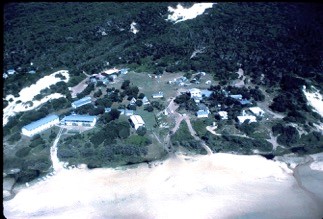
Eurong 1985. FIDO’s interpretative Nature Walk covers what was three decades ago an active sandblow (see white patch at the left of the photo). This former sandblow is now in the process of colonisation by vegetation. FIDO will be interpreting the vegetation and landscape between the Resort and the houses of Residential Valley
Between the two valleys, one of which is occupied mainly by the resort site and the residential valley where most of the village’s houses are located, are the remnants of sandblows that were very active when the village was surveyed in 1963. After getting on top of the weeds in this Unallocated State Land, FIDO is embarking on an ambitious and most interesting project to establish an interpreted nature walk that describes the connection between climate, soil and vegetation. This will help visitors and residents to better understand the vegetation patterns and how they are largely related to soil development.
The interpretation on this fascinating easy 10 to 20-minute stroll explains one of the keys to understanding the development of the diversity of Kgari’s vegetation patterns. The impact of sandblows on Melalueca growth will be a special feature of the walk, which shows entombed and exhumed Melaluecas that may be thousands of years old.
John Sinclair (AO), FIDO
The Impact of Sandmining on Fraser Island’s Natural Integrity
The 10th anniversary of FINIA at Dilli Village is also a reminder that sandmining ended on Fraser Island only 39 years ago, after churning up about 200 hectares of dunes. The six-year long Queensland Titanium Mines project was responsible for mining in the narrow coastal strip between North Spit and Dilli Village, an area comprising half that of the total area mined. A further 100 hectares was mined by Dillinghams (after which Dilli Village is named), within two kilometres of Dilli Village to the southwest. This much larger operation, conducted in an area of taller forests and well-developed dunes, lasted one and a half years.
Having spent such a turbulent part of my life working to stop the sandmining, I was keen to take a recent opportunity to see how accurate I was in my assessment made 40 years ago of the impact of mining. This excursion, made on 27 October, was an interesting one, as it was the first time for a few years that I have ventured into the areas previously mined by Dillinghams. The reason for my infrequent visits is that the site is unattractive, off the beaten track and difficult to access and move around in, due to the number of dead trees and scratchy branches.
My cursory inspection of this area, mined in January 1976, confirmed what I had predicted in the 1970s and what I had previously observed since mining and rehabilitation ceased in 1978. I believe that it will take hundreds if not thousands of years for this disturbed land to recover. First and foremost, the soil has to develop a profile. Fraser Island (Kgari) is known for its remarkable podzolic soils, the profiles of which develop in complexity over time, as do their corresponding plant communities. Dune System 1 (using Cliff Thompson’s criteria) is characterised by no differentiated A and B horizons. No Eucalypts occur naturally on these soils. Some Eucalypts, notably Scribbly Gums and Bloodwoods occur in Dune System 2, where definite A and B horizons can be observed. The further development of these horizons corresponds to increasingly large stands of trees. However, it is usually only on the more established and complex soils, in Dune Systems 3 and 4, that one will find Blackbutts (Eucalyptus pilularis).
Developing a soil profile in the mined area is taking much longer than anticipated. This is surprising because in sandblows the transformation from Dune System 1 occurs with relative speed. I can nominate a number of areas that were sandblows less than 40 years ago, but where natural plant succession now includes Eucalypts. However, on the mined areas, the only Eucalypts occurring now were hand planted, and other than wattles, very few plants have volunteered. Of those plant species that grew in this area before mining, only a fraction are now evident, and of these, all occur in much lower numbers (e.g., Phebalium). Wattles seem to dominate, but almost all of the original wattles have succumbed to age and the next generation is much smaller and weaker. I remain amazed at the lack of biodiversity on the mined site.
The most interesting observation I made during my expedition regards the development of the Blackbutt trials, established by the Queensland Forestry Department back at the end of 1975. This area adjoins the mined area, but it was not mined. Before clearing to establish the Blackbutt monoculture, this was a Dune System 2. Therefore, the development of the Blackbutt defies the rule that Blackbutt do not occur except in Dune Systems 3 and 4. While I suspect that the facilitator of this surprising growth was the application of fertilizer that accompanied the planting, it is nonetheless interesting that the establishment of this Blackbutt monoculture challenges understandings of where Fraser Island (K’gari) plant communities should occur.
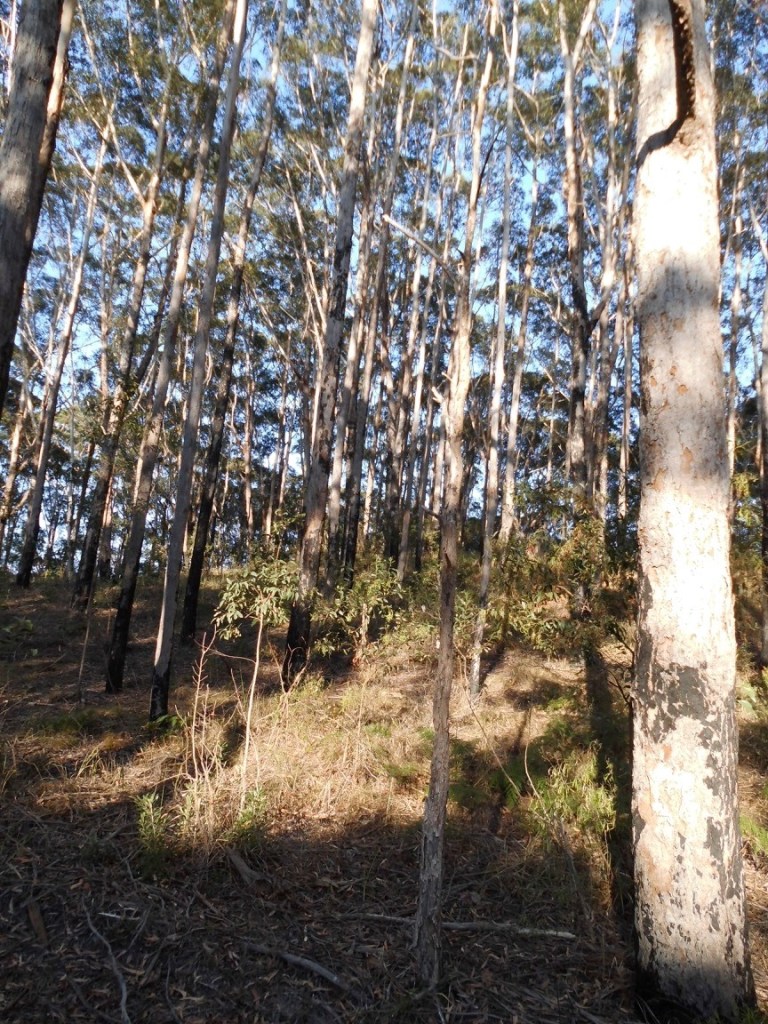
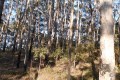
The experimental Blackbutt plantation, established by the Queensland Forestry Department in 1975, 40 years later. The area lies adjacent to a mined area, over the hill.
Another notable feature of the former Dillingham mine site is the lack of any small understory plants. This applies equally to the Blackbutt plantation. This is particularly noteworthy considering that almost any other forested area on Fraser Island now has an uncomfortably thick understory. This could indicate damage caused to the soils in these areas by sandmining, as well as the disruption of the seedbank, which will affect the recovery of the site. It is fair to say that sandmining had an enormous impact on the integrity of Fraser Island (K’gari)’s soils and plant communities, and that recovery will take significant time and care.
John Sinclair, AO
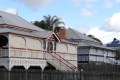
What have Maryborough Heritage Houses to do with FINIA?
FINIA and others concerned with preserving natural integrity can learn important lessons by examining why so many of the wonderful heritage houses of Maryborough have been preserved, restored and protected without any conservation orders applying to them.
I grew up in Maryborough and spent the first half of my life there. I still love the place. This once prosperous river port city for decades escaped the development and re-development boom that has transformed most other Queensland regional centres. The result was that Maryborough was left with the best assemblage of vernacular architecture in the form of its wonderful and unique old ‘Queenslander’ wooden houses. However, these are difficult and expensive to upkeep: paint and deteriorating wood is costly and difficult to replace and renew. Thus, during the 1950s to 1970s many were destroyed, replaced or modified.
In the mid-1980s, Maryborough’s locals began to appreciate the heritage value of these unique buildings. Despite modern homes costing less and usually being better designed functionally, people were willing to pay a premium to be the proud possessors of a heritage home, all extra expenses included. The result is the lavishing of love and care on hundreds of homes that can’t be taken to vintage car rallies or even placed in any competition.

Maryborough’s heritage houses have strong public appeal
Now these houses are being lovingly cared for and renovated in their original style. Some wrecks, far from being destroyed, have been painstakingly restored with a passionate pride. This has been accomplished without any legal status being given to the houses. The National Trust hasn’t listed them, and most have no other preservation orders placed on them.
Maryborough thus demonstrates the major benefit of people having a greater appreciation of unique heritage value. The zeal to preserve displayed here is an interesting phenomenon of developing community pride as a basis for the better management of our heritage. While this example relates to our built heritage, it can easily be extended to protecting our natural heritage. Recall that community proprietorial response made oil-drilling on the Great Barrier Reef unthinkable, and an Australia-wide sense of ownership stopped the Tasmanian Government destroying the Tasmanian wilderness to generate hydro-electricity. The more people who take pride in and value our heritage, be it Maryborough’s heritage houses or the natural integrity of a unique asset such as World Heritage Fraser Island (K’gari), the more ‘watchdogs’ there will be out to protect it.
For K’gari, if more people can be brought to appreciate the island’s natural values, this will increase the numbers prepared to act to preserve and/or restore its natural integrity. It boils down to a matter of pride. Thus, the greatest value of World Heritage status isn’t the additional legal layer of protection added by the Commonwealth assuming some responsibilities, but more particularly the layer of protection that comes from a public that recognises in the status the site’s unique heritage value.
One of FINIA’s challenges is to engender in the public a pride and passion for K’gari similar to that of Maryborough home owners for their heritage houses. A visitor centre where people can learn about K’gari’s natural values would go a long way towards achieving this. This explains why FIDO so passionately wants to see an impressive visitor centre created for Fraser Island and Great Sandy Strait sooner rather than later.
John Sinclair (AO), FIDO
Visitor Centres Vital to Public Natural History Appreciation
Because visitor centres play such an important role in elevating public appreciation and understanding of complex natural ecosystems, I have become a passionate advocate for having a world class visitor centre for Fraser Island. (more…)
End of an Era…
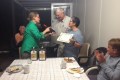
John Sinclair and Su Dawson from Fraser Island Defenders Organisation (FIDO) hosted their last weeding trip to Eurong as group leaders in May this year. This was quite a momentous occasion as John has been leading groups of volunteers to carry out weed work on Fraser Island for over 10 years.
Under the stewardship of John and Su, one aspect of the Eurong project has been to demonstrate to landholders the positive attractions of growing only natives and replacing exotic species. This is done mainly through demonstration gardens at the Eurong Resort, from which many of the worst weeds originated.
Another facet has been dealing with the weeds that have escaped from the gardens and invaded the surrounding bush. The project has given higher priority to the larger weeds, such as lantana, Easter Cassia and Brazilian Cherries, due to their potential to have the greatest ecological impact on the forest. However, while there has been notable success in reducing and almost completely eliminating these in the urban area, other weeds have now become a higher priority because their windblown seeds have been dispersed much further than previously known. These weeds are now well established outside the dingo fence and tracking them down will be a challenge for the future.
FIDO’s project also engages volunteers in the monitoring of the natural integrity of Fraser Island. A project to assess the environmental impacts of sediments being washed off the roads is now being developed and refined in collaboration with the University of the Sunshine Coast.
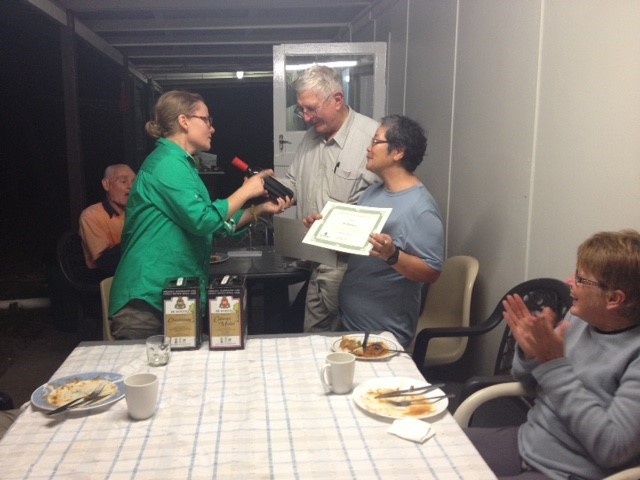
John and Sue receiving their certificate of appreciation, and a nice bottle of Shiraz
John and Su will continue to be involved in maintaining the natural integrity of Fraser Island, however Maree Prior from Cooloola Coastcare will be taking the central role in leading the groups of volunteers in the future.
Thank you to John and Su for your tireless contribution over many years.
Kath Nash, BMRG
FINIA is turning TEN
When FINIA was founded in December 2005, the catalyst was a two-day gathering of a large number of groups and agencies at Dilli Village, Fraser Island, organised by the Burnett Mary Regional Group. Nobody then could have imagined that an organisation that has a set of objectives but no formal constitution, and therefore no formal membership, could have survived for so long and achieved so much just through communication and collaboration. (more…)

Stowaway Antics – a story for children
John Sinclair’s children’s stories always carry a message and this one is no different – with the story of some suburban ants that plan their escape to Fraser Island. Suitable for children or adults (who will also get some fun out of the story), you should approach it with ANT-ICIPATION!
To download John’s story, please click here: Stowaway Antics
 FINIA
FINIA 