Home » Weed and Pest Management (Page 15)
Category Archives: Weed and Pest Management
Fighting Triffids
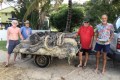
Peter Shooter continues to lead his teams of FIDO volunteers in their never-ending war against the very aggressive and invasive African subspecies of Abrus prectorius.
(more…)
Green Army Battles for K’Gari’s Natural Integrity
Work is underway in Fraser Island World Heritage area by the first 9-person Green Army team, which includes three young Butchulla men. Despite encountering hold-ups in gaining approval for overnight residence on the island, as well as delays in beginning training, the Green Army team is being kept busy with the important tasks of removing rubbish, lantana, groundsel and other weeds from the main entry road near the Wanggoolba ferry landing, and lantana control in Dundubara creek.
As they return each week as part of their six-month program, every member of the team is gaining a greater familiarity with Fraser Island (K’gari) and personally benefitting from the training and experience they are receiving. As part of their work, the Green Army team has received training in safe chemical use, as well as fencing construction and deconstruction. They have been using these new skills to contribute to K’gari’s natural integrity.
It is hoped that as the program progresses, the productivity of future teams will benefit from overcoming the challenges that any new partnership arrangement must face (especially for an area as significant as the Fraser Island World Heritage Area). In this way, we hope that the CVA Green Army teams will be an ongoing presence on Fraser Island and will be able to make an even greater contribution to weed and erosion control in some very critical areas of K’Gari.

Work Continues on George Haddock Track
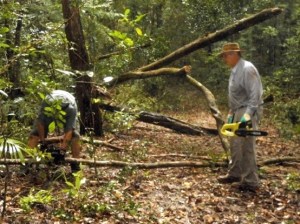
Track clearing was done manually, with little assistance other than from battery-operated chainsaws to deal with larger tree-falls across the track
Over the 2016 Easter weekend, 16 volunteers helped to honour FIDO’s obligation to maintain the George Haddock Track. The team cleared 17 km of track of fallen timber and major regrowth. During 2014, FIDO and National Parks Association of Queensland volunteers cleared 22.7 km of walking tracks along former logging tracks and roads in nine different sections of the 52 km George Haddock Track, supported by a Friends of Parks grant. No maintenance had been done since October 2013, except for a little clearing between Lake Coomboo and Hidden Lake.
During these latest clearing efforts, the swathe of cleared ground around the Harold Charles Barracks was greatly extended by stripping away regrowth and accumulated fallen debris. This will provide critical infrastructure with a greater safety margin from potential fires. It also created a larger flat area for campers participating in future working bees.
John Sinclair (AO), FIDO

Call for Volunteers to work on K’gari, Second Half 2016
FIDO has been conducting week-long working bees to tackle the urban weeds of Fraser Island for more than a decade. With support of other organizations aiming to improve the natural integrity, FIDO is determined to bring the urban weeds in the townships of Eurong and Happy Valley under control. (more…)

Fraser Island to Benefit from Commonwealth Funding for Green Army Projects
The Fraser Island Defenders Organization has been provided with funding as Project Host as a result of Green Army funding for two projects from the Department of Environment and Heritage. The service provider for these projects will be Conservation Volunteers Australia.
The project, Restoring the balance in weed and erosion management on Fraser Island, will commence in late February and again in mid-August and run for 20 weeks. The six participants will range from 17 to 24 years old, and will be provided with training, including Occupational Health and Safety, First Aid, chemical use and the management of small motors. They will gain hands on skills in weed management, erosion control and will be fortunate to have advice and information from the QPWS rangers who will direct the work plan.
The participants will have their training at Hervey Bay and spend four days a week on Fraser Island working on different parts of the island. Other potential work may include:
- Easter Cassia management around Happy Valley and south to Yidney scrub
- Jamella – egg raft collection (and wasp release if training were provided), monitoring and leaf stripping
- Giant Rat’s Tail Grass control
- Eurong nursery – plant propagation and re-potting, including of Pandanus
- Great Walk track maintenance
- Track building
- Site stabilisation through erosion control and weed management on Indian Head (Takky Wooroo).
The project provides a unique opportunity to have work carried out on Fraser Island over the period of a year that would possibly take many years otherwise.
The team will work with a number of different groups on the island, including the Butchulla people, to learn about the culture and management of the island.
Libby Gardiner, Regional Manager Southern Queensland, CVA
Propagating Natives instead of Weeds
Since Fraser Island’s World Heritage nomination was prepared 25 years ago, the number of identified weeds has grown from 40 to 200. Most of the additions to the weed list are garden escapees or alien grasses and pasture plants.
Most of these alien grasses and pasture plants have arrived on K’Gari as hitchhiking seeds stuck in the under-bodies of vehicles that haven’t been cleaned adequately before going to the island, or in the luggage and freight brought inside those vehicles by island visitors. This is evident by the fact that the epicentres for the invasion of almost all of the grasses and pasture plants, such as Green Panic and Siratro, are in the township or camping reserves. By diligence, we are whittling away at these weeds that arrived essentially as stowaways.
A more difficult challenge is countering the weeds that were deliberately taken to Fraser Island as garden plants. Landholders sought to establish hardy plants that could thrive on the island with little care or attention when they were absent for long periods. Thus they came up with a group of plants that were ideal to survive if they got loose in the Fraser Island bush. Roses and many of the more classic garden plants just can’t survive on Fraser Island. However, garden plants like Clivias, Coral Creeper, Singapore Daisy, Easter Cassia, Mother-in-Law’s Tongues, Glory Lily, Mother of Millions and Fish-bone Ferns, which looked attractive around the houses and required little care, all escaped their garden enclosures and ran riot on the island. Because these plants are so hardy they are now very difficult to eradicate.
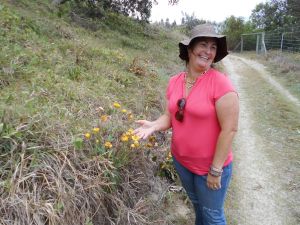
Coolum-based volunteer, Suzanne Wilson, gathering seed for the Eurong QPWS nursery. These are attractive plants that can be grown by Fraser Island landholders
Landholders are being encouraged to plant and cultivate attractive native plants. However, sourcing those plants has been a major problem. The Queensland Parks and Wildlife Service has a nursery, but lacks the staff to operate it as a supplier of plants on demand to landholders who are told not to take any plants at all onto the island.
Now, as another FINIA collaboration, FIDO and the Fraser Island Association are building up a stock of plants to entice landholders to opt to grow natives that are grown from seed collected on the island, and which, with a little tender loving care to establish them, can do just as well as the weeds we are working to eliminate. As well as purchasing pots and other nursery supplies, FIDO has been scrounging cleaned used pots and recruited a very experienced seed collector to help build up the nursery.
The resorts at Eurong and Happy Valley have set the tone by purging their properties of weeds and establishing wonderful rich gardens of natives. FIDO is prepared to cooperate with other landholders to replace exotic plants with plants from the Eurong Nursery as part of a long-term strategy to reduce weeds on Fraser Island.
John Sinclair (AO), FIDO
Weeds of the Month – Please keep your eyes open for these!
Inspections in Fraser Island townships continue every May and November, with great work occurring with the volunteer groups and residents.
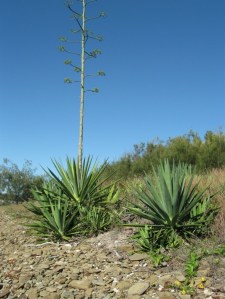
Look out for—Sisal hemp
There are still plants being brought over from the mainland seen without any known quarantine. Please think before bringing plants to the island to reduce the potential for spreading disease and pests.
We are hoping that we have tackled most of the large broad-leaved peppers in Happy Valley, but if anyone knows of any more please let us know. This also applies with the spotting of Easter Cassia and umbrella trees in Eurong.
This work could not be achieved without all FINIA associates’ assistance. Thank you.
Sisal hemp (Local Law No. 3)
Agave sisalana
- A succulent plant from Mexico, originally cultivated for its fibre.
- Tough rosette of thick sword-shaped, smooth-edged leaves to two metres.
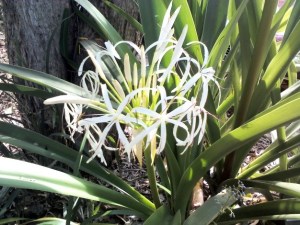
Native alternative—Swamp Lily (Crinum sp.)
- flowers green/yellow on a long central stem to over 5m
- Rhizomes sucker from the base and plantlets grow from flowering stem.
- found in rocky hillslopes, roadsides, beach dunes and older gardens.
- Carefully hand remove and bag when small.
- Chemical control by applying glyphosate through stem injection or cut, scrape and paint. Apply picloram and triclopyr (e.g., Access) at 1:60 mix with diesel using basal bark method (PER11463).
- Before using any herbicide, always read the label carefully and apply strictly in accordance with directions on the label.
Sisal Stripped to Bare Minimum
Originally from Mexico, Sisal Hemp plants grow up to two metres tall and closely resemble the native Crinium lily. As the plant matures, it produces a tall flowering spike on which smaller plants develop. Mature plants are often surrounded by younger plants that have fallen off the flowering spike. These younger plants are easily spread through site disturbance, which can roll or wash them down slopes, where they establish new colonies.
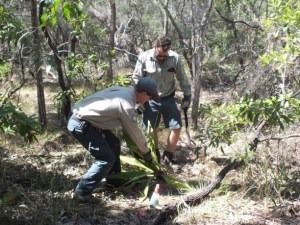
QPWS staff at work removing immature sisal
Queensland Parks and Wildlife rangers have worked to remove large patches of Sisal Hemp from land surrounding Bogimbah, Urang and Wanggoolba creeks since 2002. Contractors funded through the State Government’s strategic pest management program have also assisted staff in controlling these Sisal Hemp infestations by removing remaining plants before they reach maturity and surveying areas for potential infestations.
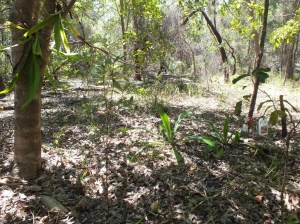
Immature sisal 2015
In the first four years, the area affected by Sisal Hemp was reduced from an approximately 3,000 square metre area, to just small sporadic re-emergences of plants. Sisal Hemp was initially introduced to Fraser Island in the 1800s, in an effort to cover the site of the Bogimbah Mission; now, native grasses and shrubs cover this important cultural site.
Help reduce the spread of introduced species by always disposing of garden waste at designated waste transfer stations. Weeds know no boundaries and management is everyone’s responsibility.
L. Behrendorff RIC NRM, Queensland Parks & Wildlife Service

Strategic Funding for Pest Management
Funding applications for state government pest management projects were recently approved for the Great Sandy National Park.

Treatment of Planthopper on Pandanus
Over 8–11 June, members of the Lower Mary River Land and Catchment Care Group, Don Bradley, Lesley Bradley and Janet Price, treated 160 Pandanus plants at Kingfisher Bay Resort and Beach Front against infestation by Jamella australiae (Pandanus Planthopper). An effort was made to locate all plants at the resort.
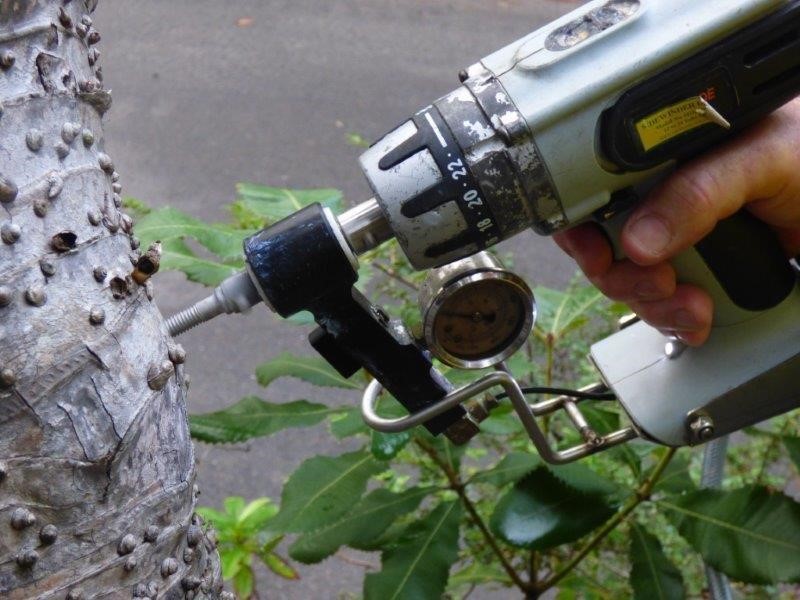
Injecting the chemical using the Sidewinder tool
In addition to the 160 plants treated, 25 plants were found to be infected with Jamella, including three in very poor condition; a further three dead plants were found. Treatment was with 50% Confidor, and involved injecting trunks and low braches, or in the case of smaller plants, spraying leaves and squirting the crowns. Size of tree and type of branching determined the number of injections per tree: trees head high received one injection; taller, single trunk trees received two injections; trees branching up high received three injections; and large trees branching received two injections per branch where branches could be reached. Infected trees were marked with blue paint.
Funding for this project was supplied by a BMRG-Chemical grant, and thanks go to QPWS for supplying the Sidewinder tool and training for the injections, and to Kingfisher Bay Resort for providing barge passes and accommodation.
Lesley Bradley, Lower Mary River Land and Catchment Care Group
 FINIA
FINIA 