The K’gari NRM wongari management team were approached by animal behaviouralist expert Nikita Ovsyanikov and his daughter Katya to meet the team and discuss non-lethal risk mitigation and animal behaviour in the human/wildlife interface.
Nikita Ovsyanikov is a world-leading polar bear researcher/scientist and animal behaviour expert visiting Australia. He also has years of experience and knowledge about arctic foxes. His interest and passion in animal behaviour have led him to develop protocols and training courses relating to the non-lethal management of large predator/human interactions. He was very interested to learn about the management (and visitor management) of wongari on K’gari.

Nikita and Katya (recently graduated with a PhD at UQ studying dolphin communication) were invited to present to staff and invited guests. Katya presented her extensive career highlights focusing on marine mammals and her amazing life working as a research assistant from a very young age with her parents observing arctic foxes and snowy owls in remote conditions.
Nikita presented his work on arctic foxes and polar bears including their current plights adapting to climate change and global warming. Interestingly, he was able to navigate his way through Polar bear areas carrying a stick for protection without bears approaching him. Like wongari – a stick acts as a visual cue to avoid approach.
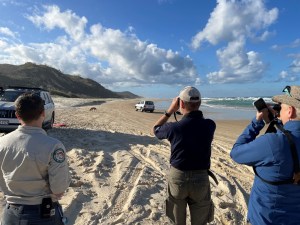
The pair were invited to see some of the situations K’gari wongari face on the eastern beach. We were keen to hear the perspectives of Nikita as he witnessed Eli Creek visitation and a response to a high-risk interaction between a wongari and a family group at the Maheno.
Thank you, Nakita and Katya, for sharing your knowledge and experiences with us. Maybe if wongari were the size of a polar bear, people would be less keen to approach them.
Article contributed by K’gari Senior Ranger – NRM, Queensland Parks and Wildlife Service (QPWS)
 FINIA
FINIA 