Although largely eradicated on the island, it’s always good to be on the watch for bitou bush (Chrysanthemoides monilifera subsp. Rotundata).
Native to southern Africa, bitou bush is an attractive, bright green perennial shrub that grows up to 5m high. It occurs in all Australian states and territories except the Northern Territory and is the dominant vegetation along much of the New South Wales coastline. Bitou bush out-competes and, in many cases, eliminate, native flora on coastal dunes destroying the habitat of many native birds and animals.
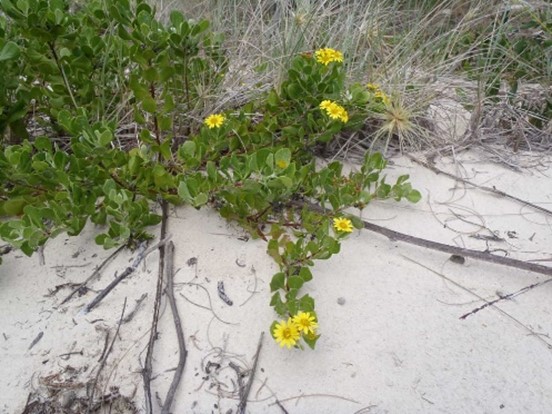
Bitou bush was originally planted in New South Wales and parts of Queensland (including K’gari) to revegetate coastal dunes following sand mining. It can still be found in the Wide Bay and in isolated spots on Noosa headland; on North and South Stradbroke Island, Moreton Island, and southern Moreton Bay Islands; and scattered along the Gold Coast beach strip.
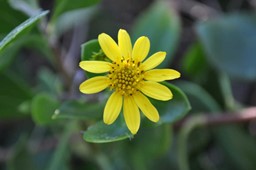
The plant has yellow, chrysanthemum-like flowers, up to 20mm in diameter, on short stalks, clustered on ends of branches. It flowers intermittently, but mainly between May and July, with the plant flowering within 6 months of germination.
The stems are much branched with woody upper stems, often purple. Leaves are 20–80mm long, teardrop shape, irregularly serrated on edges, and practically hairless except for cottony down on young leaves. They grow on short stalks and alternate along stems.
Bitou fruit is spherical with a green fleshy skin that changes from brown to black on maturity. Each fruit has one seed, which is hard and bone-like in colour and texture when ripe. Each plant can produce up to 50,000 seeds per year. Seeds are spread rapidly by birds and remain viable for at least 2 years. They germinate at any time of the year, particularly after good rain.
Methods of control include hand-pulling seedlings and plants up to 1m high. Pulling bushes is a practical treatment because bitou bush has a shallow root system with no distinct taproot, unlike many other woody weeds. Fire can also be used to destroy bitou but stimulates seed germination requiring follow-up.
Bitou bush is a category 2, 3, 4 and 5 restricted invasive plant under the Biosecurity Act 2014. You must not keep, move, give away, sell, or be released into the environment. Penalties may apply. All sightings of bitou bush must be reported to Biosecurity Queensland within 24 hours of the sighting. For more information, please read the bitou bush fact sheet.
Article adapted from Weed Spotters Network Queensland, Department of Agriculture and Fisheries
 FINIA
FINIA 