Native to northern Mexico and southwestern USA, telegraph weed (Heterotheca grandiflora), sometimes known as sticky daisy is a biennial or annual herb with hairy stems and yellow flowers.
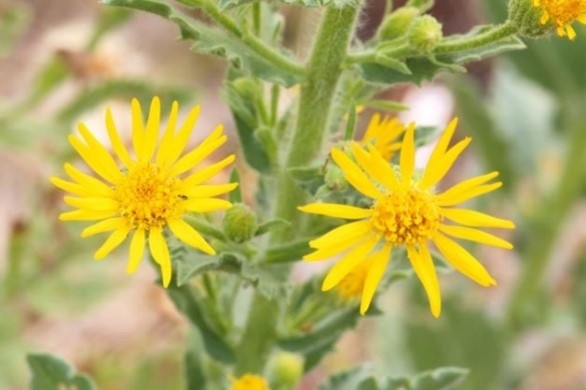
The weed prefers open, disturbed sites with dry, sandy soils forming dense infestations on sand dunes and beaches, where it can threaten native vegetation.
Telegraph weed is a common weed throughout Hawaii and was first found in Australia in central New South Wales. It was first recorded in Queensland on the Gold Coast in the early 1990s – with current infestations at Labrador, South Stradbroke, and Wavebreak Island.
Features:
- Flowering herb, up to 2m tall.
- Flowers are small, yellow, daisy-like, 15–22mm wide.
- Each flower head produces many seeds 2–5mm long.
- Produces flowers during late summer.
- Leaves are ovate to oblong, 2–8cm long, 1–3.5cm wide, arranged alternately.
- The stems are thick, densely hairy, 5–20cm long.
- The plant emits strong odour when crushed.
After flowering in the summer of one year, the plant dies back to the base, re-sprouts, and flowers again the following spring. It most commonly flowers in late summer but has also been known to flower throughout the year. In Queensland, peak seed production, which is its only form of reproduction, appears to be in late summer and autumn.
Seeds are spread by wind and water, but can also be carried on clothes, shoes, and beach towels. So please make sure you don’t carry this plant with you if you visit K’gari.
Telegraph weed is a category 3 restricted invasive plant under the Biosecurity Act 2014. For more information, please check out the telegraph weed fact sheet.
Article adapted from Weed Spotters Network Queensland, Department of Agriculture and Fisheries
 FINIA
FINIA 