Following the wildfire that affected over 50% of K’gari in October-December 2020, the IGEM Review 2020-21 identified that risk exposure mapping at the time was primarily related to people and structures, rather than significant environmental areas on this World Heritage-listed Island.
It acknowledged the importance of collaboration among key agencies and volunteer bodies, and that the sharing of Butchulla knowledge was a significant contribution to fire management. It suggested the need for a well-functioning Locality Specific Fire Management Group (LSFMG) to focus on environmentally significant areas that ‘need their own approach’.
Also important are the increasing risk of wildfire and shorter windows of opportunity for prescribed burns due to climate change, as well as the international significance of the environmental and cultural resources of this unique island.
The project focused on how to tailor fire management to best protect K’gari’s natural and cultural assets that are of outstanding international value and critical to the tourism-based economy. A University of the Sunshine Coast-led workshop was held at Dilli Village, K’gari from 20-22 April 2023 with key stakeholders including QPWS, QFES, Butchulla Aboriginal Corporation, FIDO, Happy Valley Rural Fire Brigade, Kingfisher Bay Resort, and Wide Bay Burnett Environment Council. Key outcomes included:
Collegiality and Collaboration
One of the most important outcomes was that all stakeholders at the workshop shared their perspectives and were listened to and acknowledged with respect. There was substantial agreement about communication and working together in the future.
Prescribed Burns and Cultural Burns
The purpose of prescribed burns is to reduce fuel load to protect life, the built environment as well as ecological and cultural assets. Cultural burns aim to make the land healthy again including removal of pest plant species, and managing the undergrowth to ensure that desired native species can regrow after fire. Monitoring the effects of burns can provide information to improve outcomes, and help build trust, credibility, and social licence by demonstrating the effectiveness of outcomes.
Wildfires
Unplanned fires need to be detected and responded to early and collaboratively to prevent the fire front from expanding. QFES reinforced that an Incident Management Team (IMT) needs to be formed quickly with the capacity to make decisions as soon as possible. Better coordination is needed among all agencies in future, but the telecommunication and internet network on K’gari is a major liability in enabling fire managers to communicate with each other and the community.
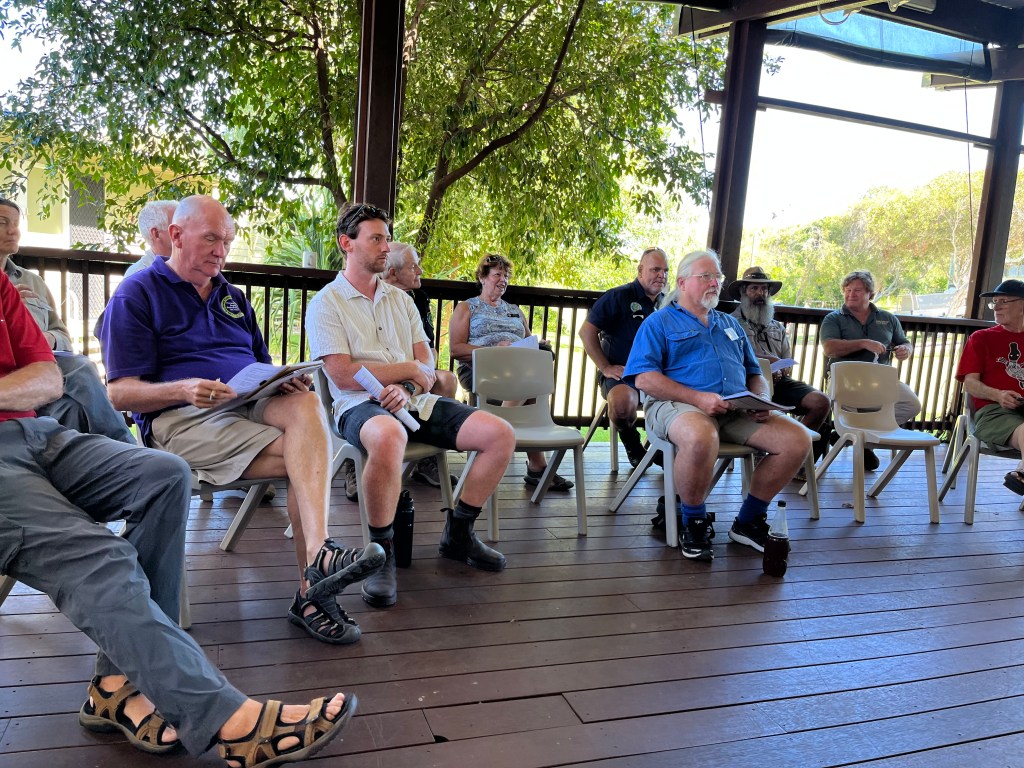
Participants in the consensus building workshop at Dilli Village 
On site – discussing site suitability and habitat needs for burning 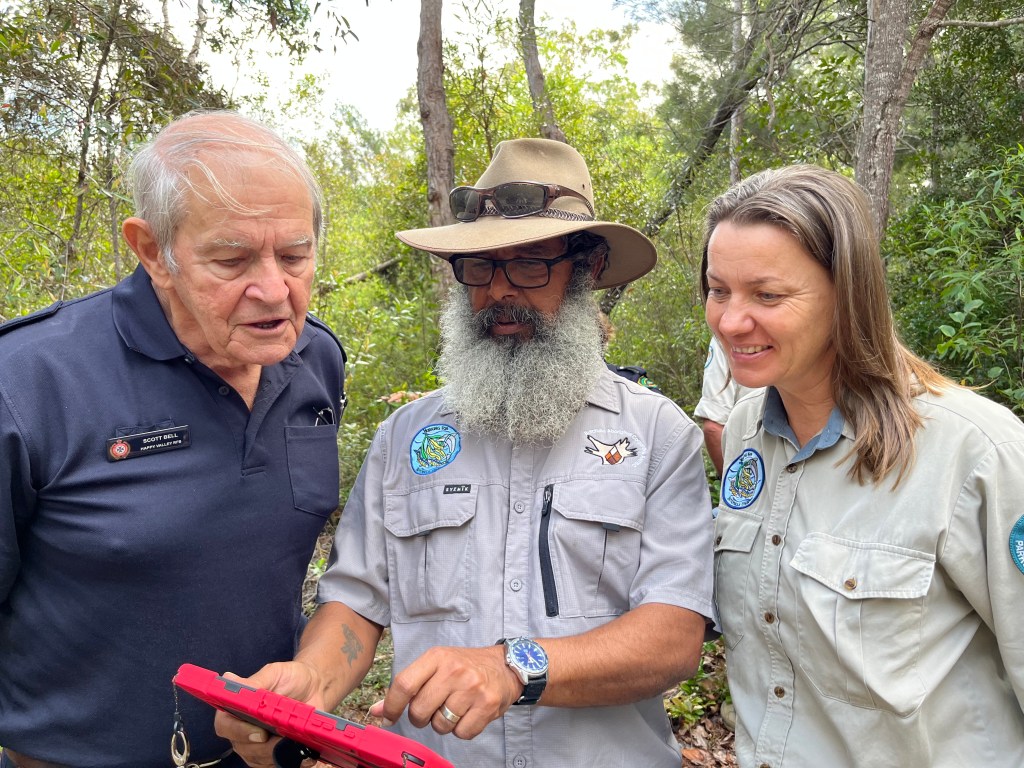
Planning for burns – recording data to protect cultural heritage 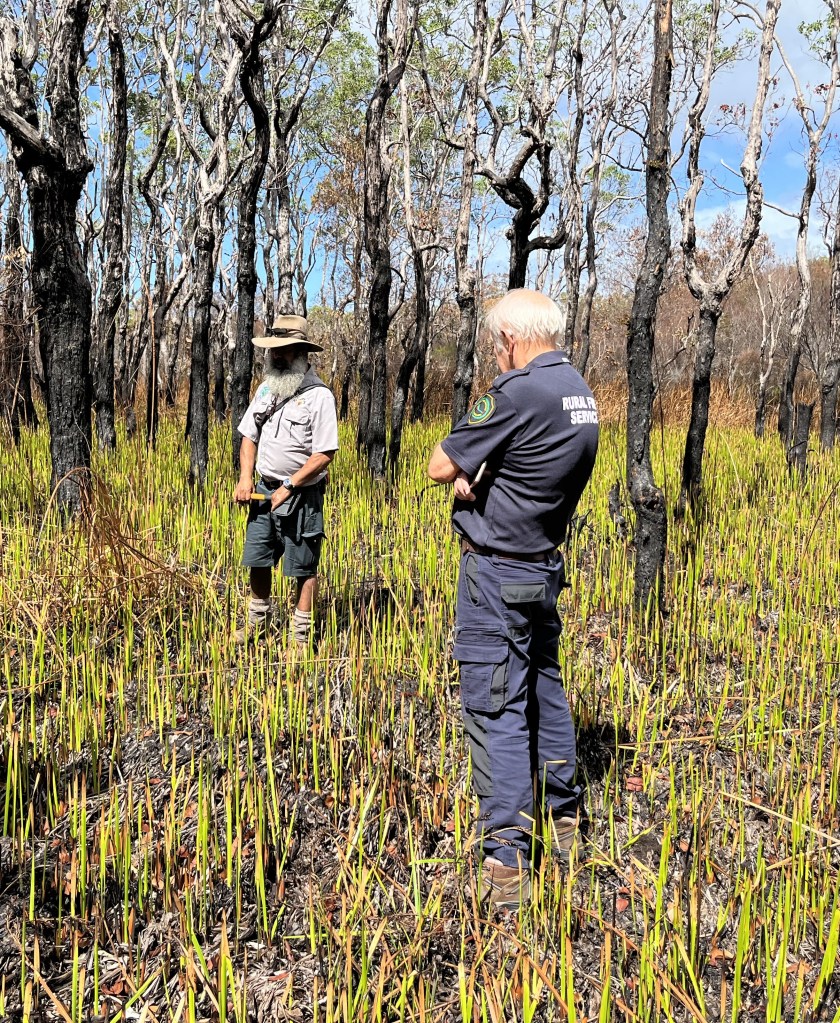
The BAC’s Darren Blake and Happy Valley Rural Fire Brigade’s Scott Bell discuss a cultural burn site 
Soil moisture is critical for a cool burn
In general, the impacts of fires on the environment are usually assessed visually and through photos documenting changes. Monitoring vegetation and fauna community recovery is essential to understand the status of vulnerable or endangered species and ecosystems, and how to manage regrowth into the future.
Some recommendations emerged to address underlying constraints identified at the workshop. They mainly require resources (budget) for:
- Improved telecommunication network for the entire island.
- Improved accommodation and resources for QPWS staff.
- QPWS to have rolling programs for prescribed burning with key performance indicators reflecting the effectiveness of the burn rather than the size of the area burnt.
- Mapping and sharing asset and equipment information ahead of time.
- Accurate public communication of fire progress during a fire.
- Public education and signage about the prevention of fires and preparedness for fires.
- Well-designed monitoring of both planned and unplanned fire severity and recovery including cultural burns.
- Similar workshops should be held again with a broader attendee list and additional focus on ecological and cultural risk mapping.
The workshop consensus was that fire management is a collaborative journey. All participants want better fire outcomes through collaboration on the ground and can help achieve this by breaking down barriers and disjointed communication.
A copy of the final report from the consensus building workshop report can be downloaded here.
Article based on the Final Report – Consensus Building on Fire Management on K’gari (2 October 2023) published by Dr Claudia Baldwin and Dr Kim Walker, the University of the Sunshine Coast
 FINIA
FINIA 