The introduction of aquatic weeds to the freshwater lakes, creeks, and streams of K’gari poses a significant biosecurity threat to the natural balance and cultural value of these important ecosystems.
There is a shortage of recent data on the freshwater systems of K’gari and their current biosecurity status is largely unknown.

Fieldwork is an important part of combatting invasive aquatic species (Photo: Tim Vance) 
Egeria densa, also known as dense waterweed or leafy elodea and Potamogeton crispus, the crisp-leaved pondweed or curly pondweed are invasive aquatic plants that can be found in Australian waterways (Photo: Tim Vance) 
Exotic water lily and Parrot’s feather another two invasive aquatic weed species (Photo: Tim Vance) 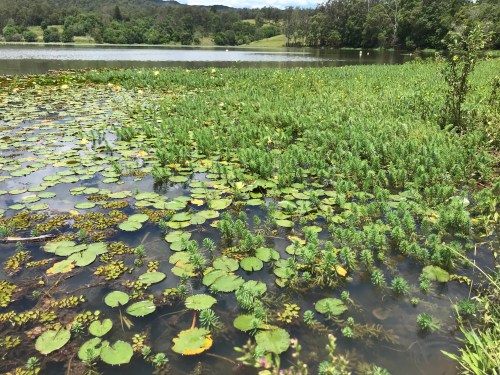
Taking a closer look at a Parrot’s feather and water lily infestation (Photo: Tim Vance) 
A dense infestation of water hyacinth (Eichhornia crassipes) can smother a waterway (Photo: Tim Vance)
On the mainland, aquatic weeds such as Cabomba, Salvinia, water hyacinth, Parrot’s feather, water lettuce and Egeria (dense water weed) have had significant negative impacts on lakes, creeks, and streams. In many cases introduced aquatic plants have replaced native species, negatively affecting the nurseries and breeding habitat for native fish, turtles, and crustaceans. When the native plants of an ecosystem are replaced by an exotic weed this also has a significant impact on the water quality in terms of oxygen and nutrient levels. Sediment loads, the flow rate and direction of waterways and the stability of the shoreline and banks can also be affected by introduced aquatic weeds. These also have impacts on the human use of those water bodies.
Many aquatic weeds have been released into the environment by irresponsible hobbyists dumping their unwanted aquarium plants into lakes and creeks. Aquatic weeds take many forms such as free-floating, submerged and emergent as well as those that are more at home on the banks of a lake or creek. A feature of aquatic weeds that makes them such a threat is that many of them can grow and establish in waterways just by a small number of fragments of the plant. Although many of these weeds have flowers and produce seeds, they more rapidly spread as ‘hitchhikers’ on vehicles and equipment as only a small fragment (think 15cm of a submerged plant or a handful of free-floating weeds). Weed fragments could very easily be brought to the island on vehicles, boat trailers, fishing gear, and watercraft. Another introduction pathway could be plant material on water-pumping machinery and firefighting equipment being brought over from the mainland.
Once introduced, aquatic weeds can be extremely difficult to manage due to their ability to rapidly spread after mechanical disturbance. Herbicides are often difficult to apply and have mixed results. In many cases, they are not the preferred option due to their off-target effects which can also impact the native plants of the area. Biological control is the use of highly specific natural enemies of the weed (insects and pathogens for example). They have been demonstrated to be safe and of great benefit in cases such as the control of Salvinia.
The introduction of aquatic weeds to K’gari could have devastating consequences for the environmental and cultural significance of this World Heritage site. Residents and visitors should remain mindful and vigilant to proactively ensure that vehicles, plant, and machinery are inspected and cleaned of any ‘hitchhiking’ weeds and soil to reduce the risk of transfer of these pests to K’gari.
Contributed by Tim Vance, a biologist with the CSIRO who has been working in a biosecurity research team on aquatic weed management for the last 8 years.
 FINIA
FINIA 