Although not common, in recent years there have been reports of Irukandji off the west coast of K’gari, particularly in Platypus Bay and around Awinya and Wathumba creeks (which are popular with campers).
Several visitors have been stung, with symptoms requiring paramedic attention or even hospitalisation, leading to a general ‘Marine Stingers’ warning in place for visitors to the island between November and May.
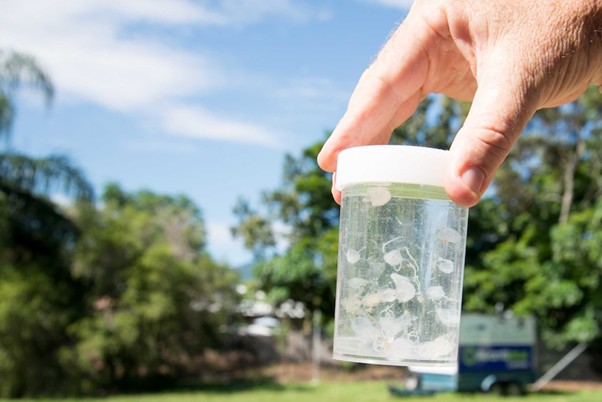
Dr Lisa Gershwin of the Australian Marine Stinger Advisory Services said Irukandji jellyfish had been recorded at K’gari for decades.
“It is nothing new — we’ve found them south of Fraser Island for more than 100 years,” she said.
But why do we find Irukandji on K’gari’s west coast in the Summer?
JCU researcher Dr Olivia Rowley said fully grown Irukandji are very difficult to track, as they are only around 35mm long and transparent, while the juvenile polyp stage of the animal is even smaller at just 1 or 2mm in length.
Using laboratory-bred polyps, scientists looked at the effects of salinity and water temperature on the polyp’s oxygen consumption and condition. Dr Rowley said that while salinity did not have a significant effect, oxygen consumption rates increased with temperature – favouring temperatures between about 28oC and 34oC, suggesting that polyps of Carukia barnesi (the Irukandji species commonly found in North Queensland) are likely to be found in an environment with stable temperature and fluctuating salinity.

Adult Irukandji have been found as far south as Fraser Island off the Queensland coast. But with winter water temperatures around 20oC, this would be unfavourable for the Irukandji polyps.
Dr Robert Courtney, from JCU’s The Australian Institute of Tropical Health and Medicine, said he had found that Irukandji polyps, which live on hard substrate, such as rocks, thrive in water that is far less salty and much cooler than the open ocean. This suggests that the breeding ground for these animals is not places like coral reefs as previously thought, but possibly around ‘wonky holes’, freshwater springs that emerge from groundwater channels in the seabed.
Interestingly, wonky holes are a known phenomenon of the Great Sandy Strait. These underwater fountains carry higher levels of nutrients than the surrounding seawater, making them a rich source of plankton and popular with fishers as they also attract fish.
Considering the location of wonky holes, and a dominant south-easterly wind direction, may be one reason why the Irukandji are mainly an issue for K’gari’s west coast.
Clearly, there is much more to learn and understand about K’gari’s smallest marine stingers.
Article contributed by Sue Sargent, FINIA
 FINIA
FINIA 