You may have noticed an added little, black, bird species in the last five years around residential areas of K’gari and on the adjoining mainland.
These are Indian Myna Birds who are very territorial, social, and flock together causing aggression and home loss to native species. These intelligent, admittedly noisy, and adaptable birds have been introduced around the world and have made their way to our World Heritage-listed island.
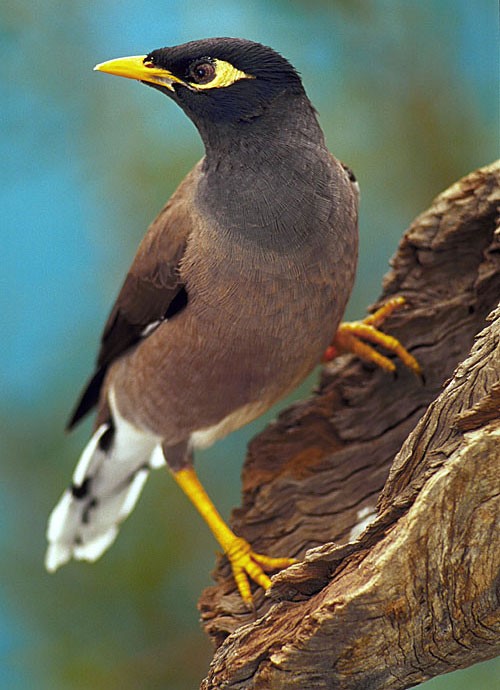


Myna birds are passerines or songbirds and are a type of starling (Sturnidae family) – Latin for starling (Sturnus). The well-known Australian noisy miner bird (bush alarmist!) is a honey eater (Meliphagidae family) native to Australia and is pale grey-coloured compared to the introduced dark Indian myna species. Mynas are monogamous and can breed from about one year old. Depending on the species, they can live from four to 25 years!
To combat the island’s Indian myna bird invasion K’gari residents and stakeholders have teamed up to manage the situation through a state-funded Collaborative Common (Indian) Myna bird program with initial funding available for a workshop, cages, and associated equipment. The workshop held at the Orchid Beach community shed provided by the Orchid Beach Association and hosted by QPWS provided information to 24 attendees keen to hear more about control options for this invasive bird species.
Jesse Wojtala from Wedgetail Solutions delivered an informative presentation outlining the species’ origin, invasive capacity and importance of controlling these adaptable birds as well as highlighting animal control welfare.
Andrew and Simon from FCRC outlined control efforts on the mainland and potential support options for K’gari. QPWS staff highlighted the distribution for K’gari and collaborative options for control and support including using Myna Scan to assist with recording control effort.
The workshop finished with a cage trap demonstration, cuppa and knowledge-sharing session. It was very interesting hearing from residents who have already been working hard at cage trap building and control options to outsmart these clever birds.
It is important these birds are not feeder-fed or encouraged to increase in population. They carry parasites and are vectors for invasive weed and pest species (potentially even including fire ants). The common myna bird will “ant” by dropping onto a fire ant nest to dust bathe or pick up the ferociously stinging ants and drop them onto its feathers. The ants’ formic acid helps to kill parasites like mites and ticks.
Working together for K’gari.
Contributed by Linda Behrendorff QPWS Senior Ranger NRM K’gari
 FINIA
FINIA 