Every three years, the International Union for the Conservation of Nature (IUCN) undertakes an independent evaluation of the conservation outlook for all natural World Heritage properties. Given COVID-19, there was a slight delay in the latest round, with the latest reports released in October 2025.
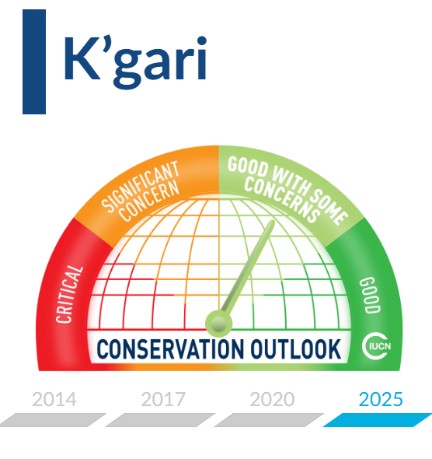
A copy of the IUCN Conservation Outlook for K’gari can be downloaded here.
On the surface, the picture painted of K’gari is one of continuing health with the same overall score of ‘Good with some concerns’ that the property achieved in 2020. A score that means that while the situation is generally satisfactory, it has a few specific issues that need attention.
Herein lies the issue, that despite consecutive reports (2014, 2017, 2020, and now 2025) highlighting the need to address threats including climate change, over-tourism and biosecurity, that insufficient resources have been applied to address these problems on K’gari.
It is not hard to identify K’gari’s threats, which continued to be classified as ‘high’. However, the following threats have now escalated from high to ‘very high’ levels in the latest report.
- Fire and fire management
- Recreational activities (Overtourism)
- Invasive non-native, alien species
- Changes in temperature, precipitation and hydrological regimes.
Reading further, we find for the first time that while the condition of K’gari’s World Heritage values continues to be of low concern, the trend is for the first time now ‘deteriorating’, informed by a deteriorating trend for ‘unique flora and fauna demonstrating ongoing succession, speciation and radiation.’ In plain English, K’gari’s unique and globally significant combination of plants and animals are suffering.
While the assessment of K’gari’s protection and management continued to be ‘mostly effective’, three areas have declined from the 2020 report from a ‘mostly effective’ to ‘some concern’ rating. These were:
- Tourism and visitation management
- Monitoring, and
- Research.
The effectiveness of management systems and governance in addressing threats originating from outside the site, e.g., Climate Change, biosecurity concerns, significant population growth, residential development and an increase in tourism and support industries in the Great Sandy Region, has also declined from ‘some concern’ to a ‘serious concern’ rating.
What does this mean for K’gari? In a national context, the property’s conservation outlook is rated as better than Kakadu National Park, the Wet Tropics of Queensland, Gondwana Rainforests of Australia and Greater Blue Mountains, all of which are now considered by IUCN to be of ‘significant concern’ with the Great Barrier Reef of ‘critical’ concern.
However, while K’gari has been spared a worsening conservation outlook, the deteriorating trend does not bode well for future conservation outlook assessments should K’gari’s land managers fail to address threats or improve K’gari’s protection and management regimes moving forward. This includes releasing and implementing the K’gari (World Heritage Area) Vulnerability Assessment and Climate Change Adaptation Plan developed by the Butchulla Aboriginal Corporation and the Department of Environment and Science between 2022 and 2024.
Since 2020, the Conservation Outlook has worsened for four of Australia’s 16 natural World Heritage properties – Ningaloo, Shark Bay, Purnululu National Park, and the Australian Fossil Mammal Sites. With a greater focus and improved resourcing for protection and management, we could prevent this fate for K’gari in the future.
IUCN has spoken, and the time to act is now.
Article contributed by Sue Sargent, Chair – FINIA
 FINIA
FINIA 