The Australian Citizen Science Association defines citizen science as ‘public participation and collaboration in scientific research to increase scientific knowledge.’
Although citizen science is a comparatively new term, first appearing in scientific literature around 1995, the collection of data or observations by community members, that were shared with scientists (or others) to increase knowledge, has been practised by Indigenous Australians for many thousands of years, resulting in tools like seasonal calendars.
Is citizen science a good thing?
Citizen science increases knowledge through monitoring or answering a research question, and provides opportunities for education and engagement by involving your local community and sharing it with others.
Citizen science can provide evidence to create community stewardship (protecting or conserving a particular place, habitat, or species), and support changes to management and policy change.
Finally, citizen science is also good for you. It promotes physical activity and connection to nature, improves mental well-being by reducing stress and isolation, and provides a sense of purpose and community.
So, can it be done on K’gari?
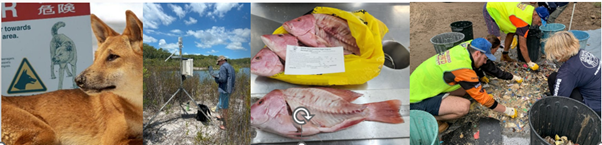
Yes, there are many examples of citizen science projects that have been, or continue to be, conducted on K’gari by our community. These include:
- Beach to Birrabeen, K’gari BioBlitz 2016 (FIDO)
- Biodiversity and biosecurity records through apps such as Atlas of Living Australia and iNaturalist.
- Bird species (Birdata by Bird Life Australia) and shorebird counts (Queensland Wader Study Group)
- Reports of negative interactions with dingo descriptions to Dingo Ranger (QPWS)
- Find a Frog in February (MRCCC)
- Keen Angler Program using fish frames and otoliths from recreational fishers to assess the health of fish stocks (DPI/BAC and fishers)
- Litter and marine debris (Tangaroa Blue in conjunction with the 4WD Queensland K’gari Clean Up)
- Photo-Point Monitoring of Boorangoora/Lake McKenzie (FIDO)
- Weather monitoring stations– passive weather monitoring at Eurong, Kingfisher, Happy Valley, Cathedrals and Orchid Beach (FIDO).
The need to monitor K’gari’s Outstanding Universal Value
Monitoring is an important component of management. However, there is currently no dedicated program for K’gari to monitor ‘World Heritage’ i.e., the features that make up the Outstanding Universal Value (OUV) of the property. Some sites and features are monitored by QPWS as part of their Great Sandy Region Management Plan, but further monitoring may be limited by resourcing.
In October 2025, the International Union for the Conservation of Nature (IUCN) released its Conservation Outlook Report for K’gari. The report identified that while overall protection and management of the World Heritage property continued to be mostly effective that monitoring and research had declined to a level of some concern. So, additional monitoring data may be useful for land managers working to protect and conserve K’gari.
What next?
A dedicated K’gari Citizen Science Program would need broad buy-in from Government agencies, traditional owners, Council, research institutions, special interest groups, and the community (including tourists).
While beneficial in delivering cost-effective information, citizen science still needs enablers. These include leadership to design and manage the program using the data, along with dedicated funding to support project coordination, training to ensure data quality, tools like apps, data management, analysis, synthesis and communication.
K’gari Conference Citizen Science Roundtable
A group of interested participants discussed options for a K’gari Citizen Science program at the K’gari Conference in November, identifying three actions needed to progress this concept further:
- Further discussion (ideally through a workshop) with key stakeholders and citizen science providers to identify potential champions and program leader(s).
- Discussion on ethical science and citizen science on K’gari and the development of a K’gari Charter i.e., obeying the three Butchulla lores, do no damage, seek to reduce threats to K’gari, authenticity (genuine scientific outcomes) and reciprocity.
- Increase our understanding of what K’gari visitors want to know or learn about, e.g., is it more information about fish, heritage, K’gari’s unique mix of plants and animals or rainforest environments? Understanding motivation will allow us to develop or refine relevant activities.
If you are interested in being part of a K’gari Citizen Science Network, please contact Sue at contactFINIA@gmail.com.
Article contributed by Sue Sargent, FINIA
 FINIA
FINIA 