Now in my third term as President of FIDO, I constantly ponder the role of FIDO for K’gari in the light of changing circumstances. Members and supporters of FIDO ask questions about its future role.
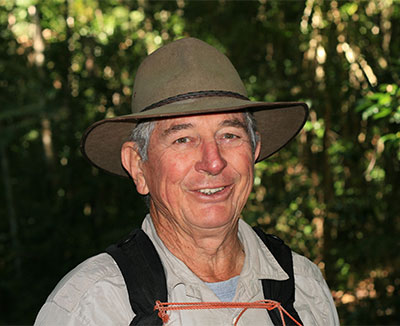
Longstanding FIDO President and environmentalist, Dr John Sinclair AO was pondering this question as early as 1992. His reasoning still applies today.
K’gari was inscribed in on the World Heritage list at Santa Fe in December 1992. After years campaigning for that outcome some might consider that FIDO should have drawn a line under its activities.
But FIDO had good reasons to continue and live up to its motto as the watchdog of K’gari. John in Saving K’gari (p.218) stated, “I knew that despite legal protection many great natural areas deteriorate overtime without continual monitoring. My experience in conservation has taught me that no environmental battle can never be permanently won. But they can be permanently lost.”
These arguments have not gone away, yet the same accusations keep coming up. After a confronting talk with a former FIDO volunteer in 2024, I wrote in my diary:
“Since becoming president of FIDO, I’ve been told by several people that the organisation is no longer required and another of these conversations occurred today. I was told that FIDO did good work back in the 1970s – bringing about the end of sand mining and being instrumental in ending the logging of the forests in the 1990s but is no longer needed. Now that World Heritage status has been granted and over 90% of the island is managed by the Queensland Parks and Wildlife Service and the Butchulla have Consent Determination, what can FIDO possibly need to do?”
John responded to a similar dilemma after one of his last trips to K’gari. He visited some of the spots that had been treasured in his memory and was distressed by their regraded condition. He wrote,
“I was astonished to realise the extent of the degradation that has occurred despite the extra layer of protection World Heritage was supposed to have delivered. It was convincing proof of the necessity for a vigilant watchdog continually monitoring and critically reviewing the situation,” (Saving K’gari p. 219).
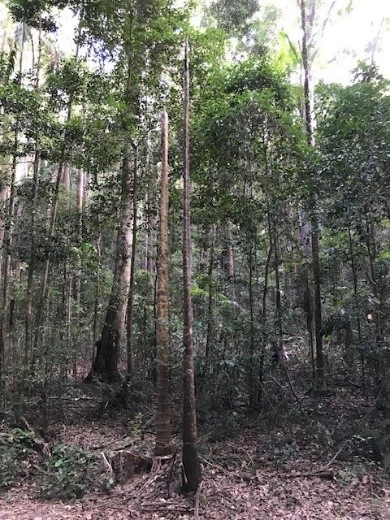
The need for constant monitoring was proven again in 2025 when a FIDO weeding team leader noticed a stand of piccabeen palms in the Yidney scrub looking distressed. This is a highly scenic rainforest area, and the FIDO observer reported it to both the QPWS and Biosecurity Queensland. A team of BAC, CSIRO and DPI staff members took samples of the soil around the affected trees. The samples were analysed and found to be a variety of Phytophthora which had not been recorded on K’gari before.
On a subsequent visit, the same person noted a similar-looking stand of ailing piccabeen palms to the north of Lake Garawongera. Once again, the matter has been reported and a soil sample is being tested. This team leader is a highly experienced person with a sharp eye for how a healthy forest should look, based on many visits walks with John Sinclair, scientists and Butchulla rangers. If a new organism is invading the rainforests, this could easily be related to the very high visitation rates and inadequate biosecurity measures employed on vehicles tyres and boots of visitors. It is extremely important to raise the alarm early rather than wait until significant areas have been devastated.
Looking back, FIDO has persisted in unflagging guardianship, and this will be elaborated in future articles. Meanwhile, multiple answers to the question, “What can FIDO possibly do now?” include weeding the USL, running lectures and contributing to symposia, participating in FINIA, supporting Bioblitizes, the new cane toad reduction program, working with Butchulla custodians, and above all, keeping a skilled and responsible eye on the health and well-being of K’gari.
Article contributed by Zela Bissett, President, FIDO
 FINIA
FINIA 