It is incredible to think that this year, marks 20 years since the formation of FINIA and their first weed workshop held on K’gari. Weeds and biosecurity are still a massive (and growing) issue for the World Heritage property and an area that concerns many of our partners.
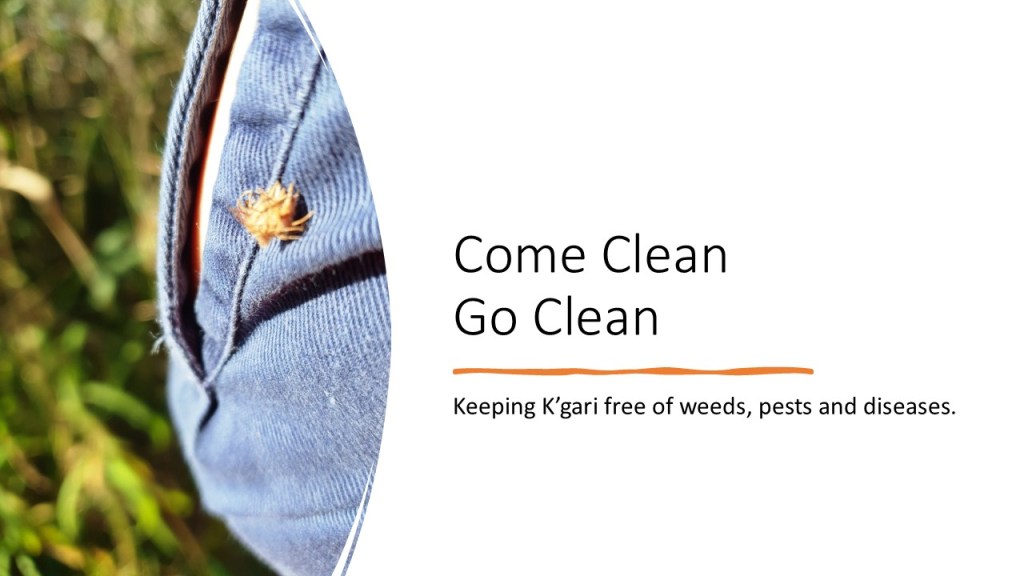
This year we reminded all members about the importance of Come Clean, Go Clean and the basic biosecurity measures that are incumbent on us all – especially when we access areas that most visitors to K’gari may never get to visit. Come Clean, Go Clean serves as a reminder to make sure you check and wash all boots, clothing (including your socks, baseball caps and hats), vehicles, camping and other equipment before coming onto K’gari.




With growing interest in the Field Trips, we also implemented a convoy procedure for our vehicles (with thanks to member Joe Elmore and the Ipswich 4WD Club). While FINIA has always practised ‘Tread Lightly’ principles and encourages car-pooling, radio handsets in each of the vehicles kept everyone well connected and ensured that the itinerary ran to schedule.
After a warm welcome to country by the Butchulla Aboriginal Corporation’s Myles Broome, Kodi Womal, Jason Booth and Miriyan Sandy, participants were each painted with three lines of ochre to remind us of the three lores while we visited Country:

What’s good for the land comes first.
Do not touch or take anything that doesn’t belong to you.
If you have plenty you must share.
First up on the itinerary was a WetCAT demonstration by Butchulla Land and Sea Rangers at Lake Allom. Members got to see the Wetland Condition Assessment Tool in action, including a close look at the lake’s macroinvertebrates, and the BAC’s new Galangoor Gung data tool (developed in conjunction with Everick Foundation).
Cane toads were also on the itinerary and although out of season for tadpoles (found over Summer), cane toad tadpole trapping was demonstrated at Govi Creek, with members constructing cane toad tadpole traps in the evening. These simple traps can be made for <$10 and then deployed overnight with a tadpole lure (which also prevent the bycatch of native fish and other species). Three partner groups signed up to FINIA’s Cane Toad Challenge and took away a free trap and supply of baits for next season.
As the day ended, Butchulla Land and Sea Rangers took FINIA members out to deploy trail cameras checking habitat for the Vulnerable Mur’rindum, Black-breasted button quail (Turnix melanogaster). Although not captured on camera overnight, the cameras did pick up several other species of K’gari wildlife including a bandicoot and goanna.
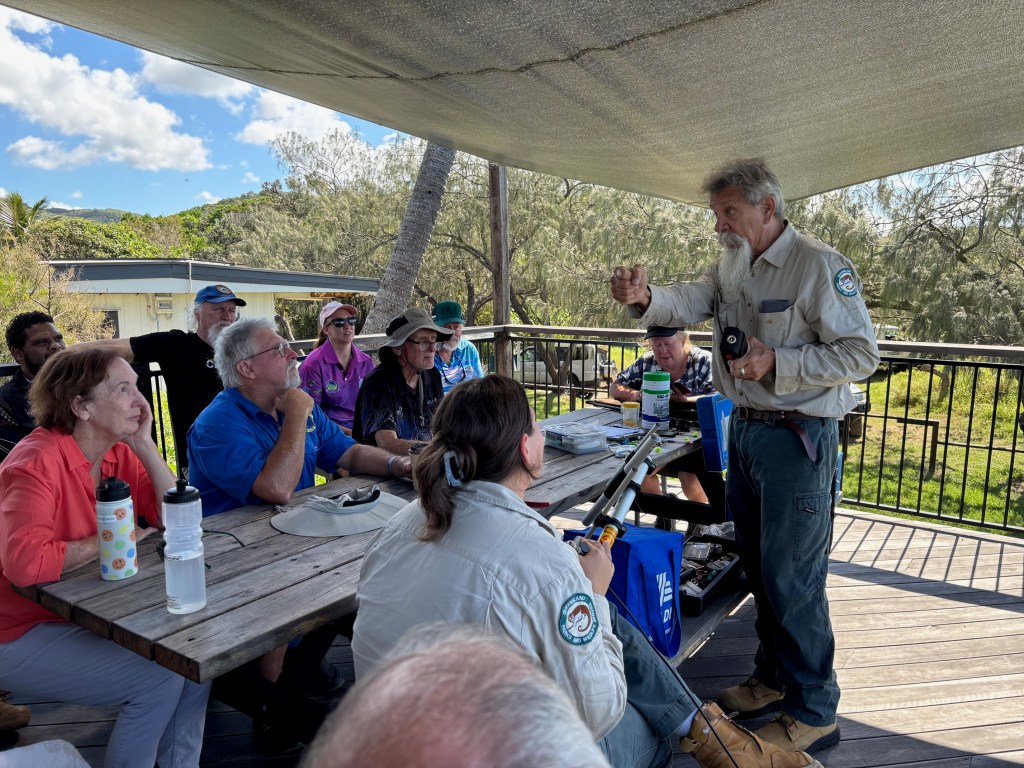
On Day 2, FINIA members were provided with a fascinating talk and demonstration of Wongari trapping equipment by Queensland Parks and Wildlife Service’s Russ Simkins and Olivia Lemma. Members even practised blow-darting a target for themselves (noting this was undertaken under strictly controlled conditions with a static target).
Following the wongari demonstration, FIDO’s Eurong Weeding Team (led by Su Dawson) took FINIA members out to the ‘Deer Farm’ (so named for its high chainlike fence – which has never housed deer). Used as a temporary storage area and adjacent to the Eurong dump, the area had a rich assortment of weeds including coral creeper (Barleria repens), corky passion vine (Passiflora suberosa), and Praxelis – all of which were marching into the National Park. FIDO intervened, starting to clear a vegetation buffer between the fence line and the bush. The buffer is now naturally regenerating with beautiful native pink nodding and tiny green hood orchids. Su and the team had set up an informative display with information about the 15+ species of weeds they had identified and the ongoing work on-site.
The final site visit for the trip was to the new pathway between First and Second (Residential) valleys in Eurong. The old pathway traversed a newly transferred Aboriginal Freehold block of land at Eurong, so the new pathway now carefully winds around the block and over the ridges to ensure that residents and visitors still have pedestrian access between the valleys. Largely constructed by long-term resident and FINIA’s Deputy Chair, David Anderson, the pathway includes steps with materials donated by ‘Mitre 11’ – aka the Eurong tip.

Organisations taking part in this year’s field trip included: Butchulla Aboriginal Corporation, Eurong Community Association, FIDO, 4WD Queensland, Happy Valley Community Association, Queensland Parks and Wildlife Service, Sandy Cape Lighthouse Conservation Association/Lower Mary River Land and Catchment Care Group, University of the Sunshine Coast, and Wide Bay Burnett Environment Council.
The field trip and meeting were proudly sponsored by Sealink Kingfisher Bay, and K’gari Research Station (Dilli Village) with catering provided by Auntie Suzie Gala (Butchulla Aboriginal Corporation). Thanks also to Su Dawson and the members of FIDO’s Eurong Weeding Team who generously provided Day 2’s morning tea.
Article contributed by Sue Sargent, FINIA
 FINIA
FINIA 