Indigenous island and coastal occupation of southeast Queensland has been one of the most intensively studied topics in Australian archaeology. The region possesses the best-documented coastal archaeological record in the country, yet the most famous and iconic landscape in this region, K’gari World Heritage Area in Butchulla Country, has been comparatively less studied.
A recent publication by the Centre of Excellence for Indigenous and Environmental Histories and Futures (CIEHF) in partnership with the Butchulla Aboriginal Corporation highlights how detailed radiocarbon dating for Waddy Point 1 (WP1) rock shelter has revealed the use of the site during colonial invasion in the nineteenth century. This discredits European archival-based histories that suggest Butchulla discontinued use of K’gari, and especially the back beach, during the colonial period.
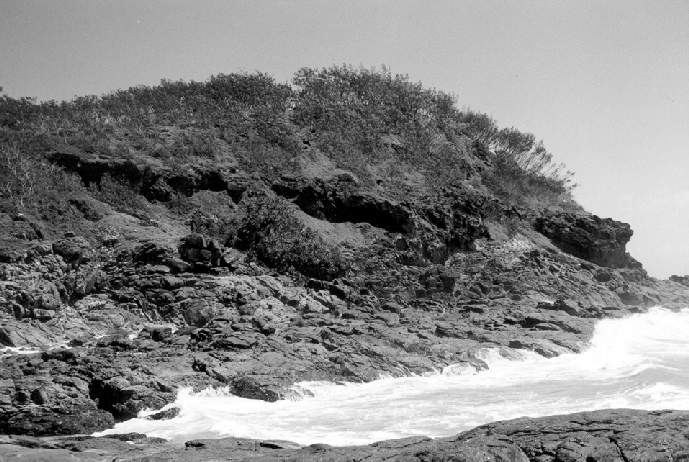
A Bayesian analysis of WP1 radiocarbon dates documents continuous occupation between c.1000 and c.150 years ago, with mollusc harvesting focused consistently on rocky shore gastropods and sandy shore bivalves. Long-term sustained mollusc harvesting also speaks to the continued importance of the sea and marine foods to Butchulla diet and identity.
Although British colonial invasion during the nineteenth century attempted to displace and erase Butchulla culture, post-contact mollusc shells in the upper levels of WP1 record Butchulla cultural resilience and possible scheduling changes in use of the site.
The history of mollusc harvesting registered at the hundreds of other midden sites along the east coast of K’gari similarly records long-term continuities in marine-focused cultural practices. Such Truth-Telling archaeological research helps redress major inadequacies in colonial archival recordings of continuities in nineteenth-century Butchulla occupation and use of K’gari.
Rogers, A. J., McNiven, I. J., & Hua, Q. (2026). Collaborative archaeological research reveals 1000 years of sustained Butchulla mollusc harvesting and cultural resilience on the largest sand island in the world, K’gari, Australia. Australian Archaeology, 1–27. https://doi.org/10.1080/03122417.2026.2718593

