The Great Sandy Strait (Korrawinga) and surrounding Hervey Bay area are known habitats for many sea cucumber species, including those that were historically targeted in the local bêche-de-mer fishery during the 1980s and 1990s.
Based on regional surveys and the Queensland Sea Cucumber Fishery (QSCF) operations, which extend down to Tin Can Bay, the following species are found in the local area:
- Sandfish (Holothuria scabra): Primarily found in the region’s shallow waters and sand flats. Sandfish are highly abundant in the soft-bottom habitats of the Indo-Pacific, including the southern region around Hervey Bay. This species is noteworthy as it forms part of the local fishery and was the focus of a commercial sea cucumber culture and sea ranching project in Hervey Bay.
- White Teatfish (Holothuria fuscogilva): A significant species found in the area, often in deeper water.
- Black Teatfish (Holothuria whitmaei): Found throughout the Queensland east coast, usually on the reef flat, down to the Moreton Bay region.
- Curryfish (Stichopus hermanni, Stichopus vastus): commonly targeted in the Queensland fishery.
- Blackfish/Burrowing Blackfish (Actinopyga spinea/Actinopyga palauensis): commonly targeted in the broader QSCF.
- Leopardfish (Bohadschia argus): Often found in sandy, shallow coastal areas.
- Brown Sandfish (Bohadschia vitiensis): Found in the Queensland region.
- Greenfish (Stichopus chloronotus): A spiky sea cucumber also common to the area.
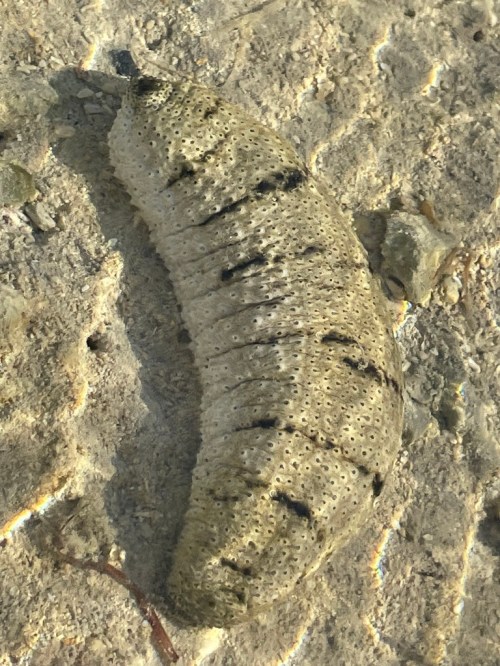
The sandfish (Holothuria scabra) Photo: CC-by-NC 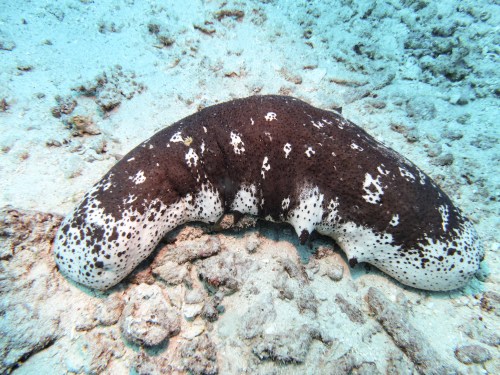
White teatfish (Holothuria fuscogilva) Photo: CC-by-NC Sue Churchill 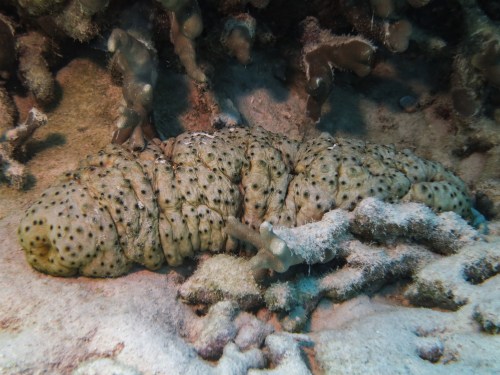
Hermann’s curryfish (Stichopus hermanni) CC-by-NC Sue Churchill 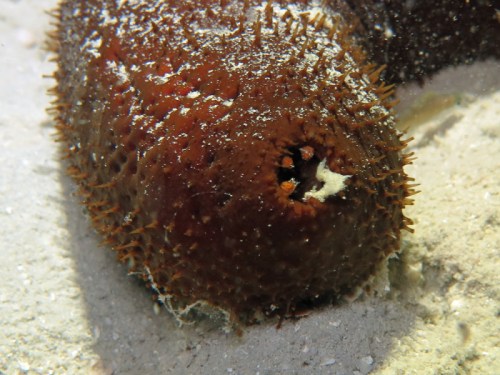
The burrowing blackfish (Actinopyga spinea) Photo: CC-by-SA Anne Hoggetts 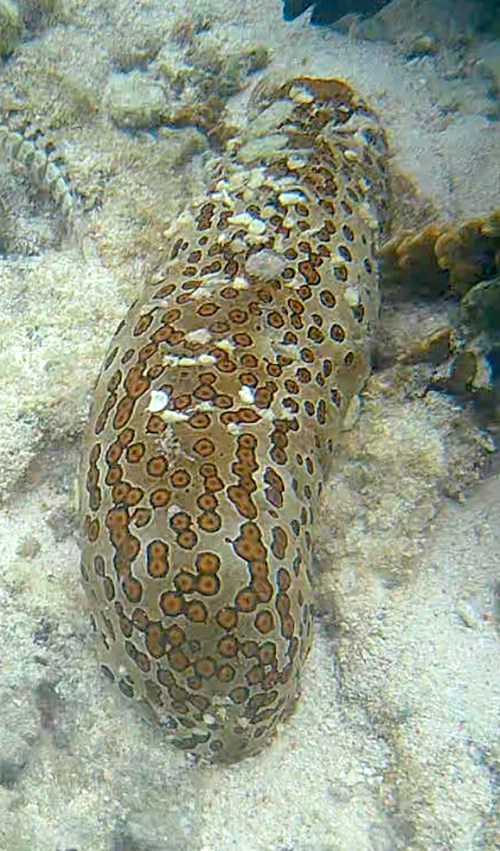
Leopardfish (Bohadschia vitensis) Photo: CC-by-NC
The Great Sandy Strait and adjacent Hervey Bay are significant areas for the QSCF, which targets several high-value species for export to Asian markets. The most important ones for fisheries in the region are sandfish, black and white teatfish, the burrowing blackfish (comprising an average of 55% of the total annual harvest in the QSCF) and curryfish (including Hermann’s sea cucumber). Sandfish are one of the highest-valued species in the trade.
The fishery is managed under a limited-entry, rotational, and quota-based system to prevent overfishing, with much of the harvest processed as bêche-de-mer. While historically important, it is noted that collecting sandfish in some areas of Hervey Bay has been prohibited to manage stocks.
A research project being led by Alison Hammond from the University of the Sunshine Coast is currently mapping the historical and current distribution of these species in the Great Sandy Strait (Korrawinga).
Article compiled by Sue Sargent, FINIA

