News
Eurong’s New Nature Trail
A comprehensive Site Visitor Capacity Study in 2008 identified Eurong as the most visited site on all of Fraser Island (K’Gari). It is the main hub for all the island’s visitors. This is one of the motivations for FIDO’s intensive efforts to improve the natural integrity of this very important site by controlling the weeds. It is why FINIA chose Eurong as the site for the Demonstration Garden Project, which aims to encourage landholders and residents to grow plants native to Fraser Island on their lots rather than propagating and spreading alien plants, many of which have turned into weeds.
In 1963, prior to any National Park being created on Fraser Island, over 250 hectares of Eurong were set aside as a township reserve. None of this reserve, which extends 1.6 kms inland with a 1.6 km beach frontage, is included in the Great Sandy National Park. The National Park Ranger Station is not part of the township reserve. Some remarkable natural features of the township reserve include wetlands and sandblows and a diversity of ecosystems. Preserving Eurong’s natural integrity is critical to the natural integrity of the National Park that surrounds it on three sides.

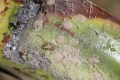
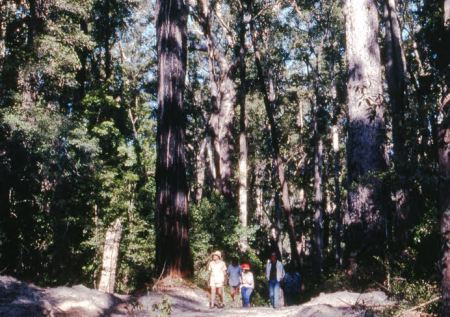
Eurong 1985. FIDO’s interpretative Nature Walk covers what was three decades ago an active sandblow (see white patch at the left of the photo). This former sandblow is now in the process of colonisation by vegetation. FIDO will be interpreting the vegetation and landscape between the Resort and the houses of Residential Valley
Between the two valleys, one of which is occupied mainly by the resort site and the residential valley where most of the village’s houses are located, are the remnants of sandblows that were very active when the village was surveyed in 1963. After getting on top of the weeds in this Unallocated State Land, FIDO is embarking on an ambitious and most interesting project to establish an interpreted nature walk that describes the connection between climate, soil and vegetation. This will help visitors and residents to better understand the vegetation patterns and how they are largely related to soil development.
The interpretation on this fascinating easy 10 to 20-minute stroll explains one of the keys to understanding the development of the diversity of Kgari’s vegetation patterns. The impact of sandblows on Melalueca growth will be a special feature of the walk, which shows entombed and exhumed Melaluecas that may be thousands of years old.
John Sinclair (AO), FIDO
Fraser Island Umbrella Organisation Turns Ten
In late 2005, a small group of dedicated people spent two days visiting weed sites on the internationally significant Fraser Island World Heritage Area in a workshop facilitated by the Burnett Mary Regional Group. The group consisted of land managers – Queensland Parks and Wildlife Service (National Park), the Department of Natural Resources and Mines (Unallocated State Land), the local council, the Cooperative Research Centre for Weeds, the National Parks Association of Queensland, Fraser Island Defenders Organisation and Sandy Cape Lighthouse Conservation Association as well as Butchulla participants Malcolm Burns, Jo Jo Gala and Marie Wilkinson.

FINIA partners gathered recently at Dilli Village to celebrate a successful 10-year partnership to help protect and restore Fraser Island’s natural assets
After those two days, it was clear to the group that weeds were just one of many issues threatening the Outstanding Universal Value of this UNESCO-listed site. Following the workshop, the Fraser Island Natural Integrity Alliance (FINIA) was formed with a goal to protect and restore the island’s natural integrity. The FINIA team developed an action plan that provided a framework for ongoing cross-tenure collaboration among the group’s participants and project partners.
Work commenced on addressing the issue of the spread of ‘garden escapees’ around the townships of Eurong and Happy Valley and the historic Sandy Cape Lighthouse that quickly became invasive weeds in the adjoining National Park. In addition to on-ground work to control weeds like mother-in-law’s tongue, Easter cassia, abrus and asparagus fern, FINIA partners also conducted workshops and awareness-raising campaigns to increase awareness and understanding of the damage these non-native, invasive weeds can cause to the island’s unique ecological environments.
As the partnership grew, so did the dedicated effort by group participants and their volunteers. FINIA collaborators ‘branched off’ to lead several other initiatives, including native seed collection; propagation and revegetation (starting with ‘Plant me instead’ replacement programs); pest management of the Jamella pandanus leafhopper and cane toad; marine debris clean-ups; research to address fire, dingo management and increase the knowledge of the island’s unique patterned fens and swamp orchids; erosion and rainfall monitoring; education and awareness (with a newsletter, website and Facebook pages); and cultural heritage mapping in conjunction with the Fraser Island World Heritage Area Indigenous Advisory Committee (which won the Queensland Landcare Award 2015 for Indigenous Land Management).
Members of FINIA gathered on the island recently to celebrate 10 years of collaboration and to review the group’s achievements—enjoying some generous sponsorship by the University of the Sunshine Coast. Mr John Sinclair AO, a long-standing advocate for Fraser Island, said that after 10 years, it was a good time to reflect and plan the next decade, with a recent workshop held at Dilli Village, where it all began. ‘FINIA provides a great vehicle to get things done. It’s overcome a number of issues that hampered on-ground work in the past, but also ensures that we all communicate more effectively’, said Mr Sinclair. ‘FINIA is the catalyst that holds us all together and makes things happen’, added Butchulla elder, Glen Miller. ‘Without FINIA, it’s unlikely that we would have been able to achieve the success we have and the range of projects that FINIA now supports’.

FINIA members observe release of the Jamella biocontrol on a Fraser Island Pandanus
The BMRG’s Conservation Partnership Manager and current FINIA Chair, Sue Sargent, was a participant in the original workshop. ‘FINIA has been an incredible vehicle for the World Heritage Area and thanks to the support of the island’s land managers Queensland Parks and Wildlife Service and Fraser Coast Regional Council, continues to thrive, picking up awards along the way’. ‘In 2011, the model was even showcased at an international conference as “the key to successful holistic weed management on Fraser Island” by Dr Alison Shapcott from the University of the Sunshine Coast—where it attracted considerable attention’.
Looking forward, although the environmental problems continue to grow, so does the strength of the partnership, with 15 partners now part of the group. FINIA’s success to date is a great example of how a supported and engaged groups of stakeholders can work together to genuinely address long-term land management issues. And as for what the next decade may hold? Well aside from more work with weeds and pests, education and awareness, FINIA is currently planning a BioBlitz to be held in 2017.
FINIA would like to formally acknowledge the Australian Government’s National Landcare Programme, the University of the Sunshine Coast (catering sponsors) and Kingfisher Bay Resort Group for their support of our tenth anniversary event.
Chris Stone, BMRG
Engaging K’Gari’s Next Generation
For those of you that check the FINIA website regularly, you may have noticed not only articles from John Sinclair, but the occasional children’s story as well.
Based around John’s experiences, the stories feature familiar landscapes, animals and even characters from Fraser Island (K’Gari), usually with a family-friendly moral or environmental message to share.
So far, on the website, you can find:
- Stowaway Antics – the story of some suburban ants who hitch a ride to Fraser Island.
- Wilflie’s War on Weeds – where Wilfie takes on Fraser Island’s woody weeds in a valley to earn money for his scout group.
- The Last Easter Cassia – where competitive mates Jacob and Herbie compete to find and remove Eurong’s last Easter cassia.
And there are more to come! Keep your eyes open over December for Happy Birthday Grandpa (about monitoring on Fraser Island), Itty Bitty and Teeny Weeny (about the Jamella leafhopper and its biocontrol agent – the Aphanomerus wasp) and Snow White – the K’Gari Bandicoot.
Submissions of children’s stories are always welcome, so if you have any stories that you would like to see published, please send them through to our Editor and Social Media Coordinator, Kellyanne Martin.
Jarvis Street Photo-Monitoring
FIDO has been weeding around Eurong on and off for decades. These efforts were initially limited to short weekend trips, which although helpful, were not cost effective. (more…)
Green Turtle Tracking at Sandy Cape
Taking advantage of turtle mating season, Aub Strydom, Peter Koch and Don and Leslie Bradley headed out to Sandy Cape over 8–15 October, laden with all the necessities for a week-long turtle-satellite-tagging trip.
Mating season provides the rare opportunity to find male turtles resting on the beach, and the team were able to tag four male Green turtles during their trip, along with one female.
Each night, the team drove the beach from Ngkala Rocks to Rooney Point, tagging every turtle they saw. The aim was to glue satellite trackers on male Green turtles, to gather information on where the males live and forage after the courting season.
Releasing the male turtle. Glue takes 3 hours to set. (Photo Peter Koch)
The female was tagged after the team beach hauled her from the shallows. She was found with courting damage and attended by a male. This particular female was first identified and tagged as a juvenile in Moreton Bay in May 1992, and was seen again in August 1994 and September 2012 around that same region. It is thought this may be her first breeding season. Her tracking data so far suggests that she is finished at Fraser Island and could be headed to her natal/nesting beach, the location of which may be revealed thanks to this tagging.
As at 18 October, the males tagged remain close to the coast of Northern Fraser Island, likely continuing to perform their courting dance. Their post–mating season data is eagerly awaited.


Submitted by Lesley Bradley
Sisal Stripped to Bare Minimum
Originally from Mexico, Sisal Hemp plants grow up to two metres tall and closely resemble the native Crinium lily. As the plant matures, it produces a tall flowering spike on which smaller plants develop. Mature plants are often surrounded by younger plants that have fallen off the flowering spike. These younger plants are easily spread through site disturbance, which can roll or wash them down slopes, where they establish new colonies.

QPWS staff at work removing immature sisal
Queensland Parks and Wildlife rangers have worked to remove large patches of Sisal Hemp from land surrounding Bogimbah, Urang and Wanggoolba creeks since 2002. Contractors funded through the State Government’s strategic pest management program have also assisted staff in controlling these Sisal Hemp infestations by removing remaining plants before they reach maturity and surveying areas for potential infestations.

Immature sisal 2015
In the first four years, the area affected by Sisal Hemp was reduced from an approximately 3,000 square metre area, to just small sporadic re-emergences of plants. Sisal Hemp was initially introduced to Fraser Island in the 1800s, in an effort to cover the site of the Bogimbah Mission; now, native grasses and shrubs cover this important cultural site.
Help reduce the spread of introduced species by always disposing of garden waste at designated waste transfer stations. Weeds know no boundaries and management is everyone’s responsibility.
L. Behrendorff RIC NRM, Queensland Parks & Wildlife Service
Weeds of the Month — Please keep your eyes open for these!
Have you noticed plants in your gardens escaping and spreading into other parts of your garden or neighbourhood? You can help stop this spread by removing these invasive plants wherever you see them and planting better alternatives that benefit the garden’s diversity and reduce the possibility of weedy plants invading.
Check the health of plants before bringing them into your garden or you may spread diseases like Myrtle rust, which is now prevalent on the Fraser Coast. For further details about this rust, contact your local nursery, Council or DPI&F.

Brazilian Cherry (Eugenia uniflora)
Flowering now!
Environmental weed
Origin: South America
Dispersal: Spread by birds, small mammals and water.
Location: Found in older style gardens along foreshore and riverside areas. Often used as an ornamental garden plant.
Description: A medium shrub, with dense rounded habit. Grows 3-6m tall. Oval leaves, with pointed tips and red new growth. Succulent ribbed orange/red fruits. Forms dense stands outcompeting native plants.
Control: Control with registered herbicide like glyphosate. Cut and paste stumps within 20 seconds.

Glory lily (Gloriosa superba L.)
Environmental Weed Declared under Local Law No. 3 (2010) for Fraser Island ONLY.
Origin: Africa and Asia.
Dispersal: Spread in garden refuse and by birds.
Location: Found in bushland, coastal habitats and gardens. Tolerates nutrient-poor soils.
Description: Perennial herb with climbing stems with tendrils at the tips. The narrow shiny green leaves die off in winter, reshooting from long-lived underground tubers. Flowering occurs in October to May. The yellow, orange and red flowers have turned back petals that expose the stamens.
Control: Control by collecting and destroying seedpods, and digging out and bagging small patches ensuring tubers are removed completely. Chemical control in December and then February using glyphosate and water at 1:50(20mL/L) + Metsulfuron methyl at 1.5g/10L water (with surfactant).
Before using any herbicide, always read the label carefully and apply strictly in accordance with direction on the label.
Shorebirds in Decline
In the last couple of months many of you may have noticed the increasing number of shorebirds on our coastline as the birds return from their Siberian and Alaskan breeding grounds. But how many of you have noticed that there are less than last year, and that they are declining year on year?
Australia’s migratory shorebirds are true athletes in the avian world. They spend the Australian summer with us before departing in April and May for their marathon journey north. Most stop off and feed along the Yellow Sea coast of South Korea and China before their final move to their breeding sites in northern China, or further north in Siberia and Alaska. They then return, some species flying nonstop back to join us in Australia the following summer.

Another of our region’s remarkable shorebirds, the red-necked stint. Photo taken just prior to release, after banding.
We’re fortunate to have two protected shorebird areas in our region, Moreton Bay and The Great Sandy Strait, which ensures our shorebirds are protected while they’re here. Unfortunately this isn’t the case in the Yellow Sea, where land reclamation, disturbance and reduced sediment flow in rivers are all reducing the feeding areas for our migrating shorebirds. As a result many species are declining rapidly.
Regular counts in Great Sandy show that the curlew sandpiper has declined by 46% since counting began 22 years ago, and big declines have also been recorded for other species, such as the eastern curlew. This year, both of these species were raised to a status of “critically endangered” by the Australian government, and more species will follow.
The Australian government are using count and banding data to lobby governments to better protect these birds and their habitats in Asia. However, we also have a role to play locally to ensure shorebirds have safe havens here to feed, rest and prepare for their epic northwards migration. So please play a role in helping to support our protected areas, and if you are a regular beach goer, as many of us are, when you next see these remarkable shorebirds, please just give them a little bit of distance, to prevent disturbing them.
Jon Coleman, Queensland Wader Study Group
The Impact of Sandmining on Fraser Island’s Natural Integrity
The 10th anniversary of FINIA at Dilli Village is also a reminder that sandmining ended on Fraser Island only 39 years ago, after churning up about 200 hectares of dunes. The six-year long Queensland Titanium Mines project was responsible for mining in the narrow coastal strip between North Spit and Dilli Village, an area comprising half that of the total area mined. A further 100 hectares was mined by Dillinghams (after which Dilli Village is named), within two kilometres of Dilli Village to the southwest. This much larger operation, conducted in an area of taller forests and well-developed dunes, lasted one and a half years.
Having spent such a turbulent part of my life working to stop the sandmining, I was keen to take a recent opportunity to see how accurate I was in my assessment made 40 years ago of the impact of mining. This excursion, made on 27 October, was an interesting one, as it was the first time for a few years that I have ventured into the areas previously mined by Dillinghams. The reason for my infrequent visits is that the site is unattractive, off the beaten track and difficult to access and move around in, due to the number of dead trees and scratchy branches.
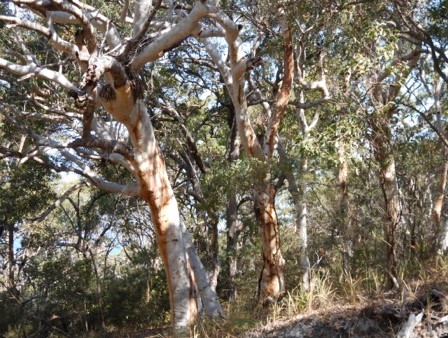
My cursory inspection of this area, mined in January 1976, confirmed what I had predicted in the 1970s and what I had previously observed since mining and rehabilitation ceased in 1978. I believe that it will take hundreds if not thousands of years for this disturbed land to recover. First and foremost, the soil has to develop a profile. Fraser Island (Kgari) is known for its remarkable podzolic soils, the profiles of which develop in complexity over time, as do their corresponding plant communities. Dune System 1 (using Cliff Thompson’s criteria) is characterised by no differentiated A and B horizons. No Eucalypts occur naturally on these soils. Some Eucalypts, notably Scribbly Gums and Bloodwoods occur in Dune System 2, where definite A and B horizons can be observed. The further development of these horizons corresponds to increasingly large stands of trees. However, it is usually only on the more established and complex soils, in Dune Systems 3 and 4, that one will find Blackbutts (Eucalyptus pilularis).
Developing a soil profile in the mined area is taking much longer than anticipated. This is surprising because in sandblows the transformation from Dune System 1 occurs with relative speed. I can nominate a number of areas that were sandblows less than 40 years ago, but where natural plant succession now includes Eucalypts. However, on the mined areas, the only Eucalypts occurring now were hand planted, and other than wattles, very few plants have volunteered. Of those plant species that grew in this area before mining, only a fraction are now evident, and of these, all occur in much lower numbers (e.g., Phebalium). Wattles seem to dominate, but almost all of the original wattles have succumbed to age and the next generation is much smaller and weaker. I remain amazed at the lack of biodiversity on the mined site.
The most interesting observation I made during my expedition regards the development of the Blackbutt trials, established by the Queensland Forestry Department back at the end of 1975. This area adjoins the mined area, but it was not mined. Before clearing to establish the Blackbutt monoculture, this was a Dune System 2. Therefore, the development of the Blackbutt defies the rule that Blackbutt do not occur except in Dune Systems 3 and 4. While I suspect that the facilitator of this surprising growth was the application of fertilizer that accompanied the planting, it is nonetheless interesting that the establishment of this Blackbutt monoculture challenges understandings of where Fraser Island (K’gari) plant communities should occur.

The experimental Blackbutt plantation, established by the Queensland Forestry Department in 1975, 40 years later. The area lies adjacent to a mined area, over the hill.
Another notable feature of the former Dillingham mine site is the lack of any small understory plants. This applies equally to the Blackbutt plantation. This is particularly noteworthy considering that almost any other forested area on Fraser Island now has an uncomfortably thick understory. This could indicate damage caused to the soils in these areas by sandmining, as well as the disruption of the seedbank, which will affect the recovery of the site. It is fair to say that sandmining had an enormous impact on the integrity of Fraser Island (K’gari)’s soils and plant communities, and that recovery will take significant time and care.
John Sinclair, AO
Sand, Sea and Sun a Success!
On 12 August, more than 100 delegates attended the 6th Biennial Fraser Island Conference at the University of the Sunshine Coast at Sippy Downs. It was the best attended Fraser Island (K’Gari) Conference yet, and with the weather for the Conference being most pleasant, as was the venue and the catering, it was also judged to have been the best Fraser Island Conference so far.

For the Conference FIDO commissioned three banners that helped set the stage quite literally.
The Conference provided a wealth of information about the world’s greatest sand island and what is being discovered to help it to be better appreciated and better understood. As the speakers made clear, the island is much more than sand; it is affected by and affects the marine environment surrounding it. A summary of the Conference, including details of all speakers, can be found on the FINIA blog.
The 7th Biennial Fraser Island Conference is also already in the works, with the theme ‘Time, Tide and Tourism’. The plan is to hold the Conference to coincide with the Brisbane Exhibition holiday on Wednesday 16 August 2017; however, more information will be made available closer to the date.
John Sinclair, AO