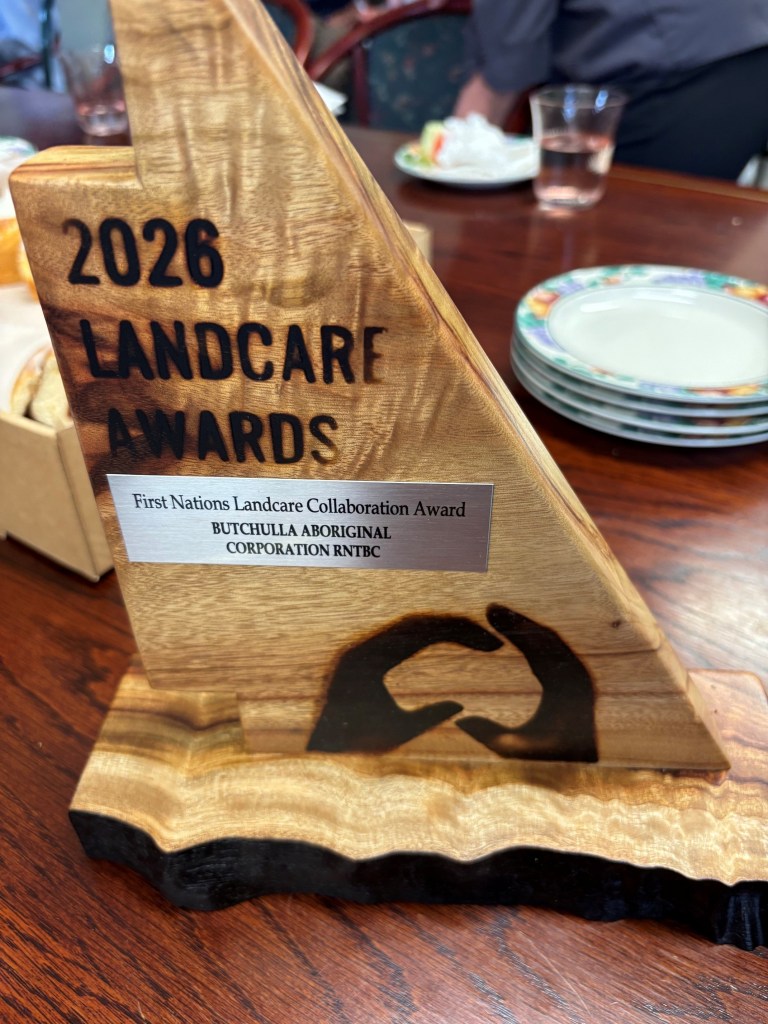
Butchulla Aboriginal Corporation (BAC) has won the First Nations Landcare Collaboration Award at the biennial Queensland Landcare Awards, held on Saturday 10 October. The award recognises partnerships that bring First Nations-led cultural land, sea and water management practices into broader landcare efforts, supporting sustainable and inclusive natural resource stewardship.
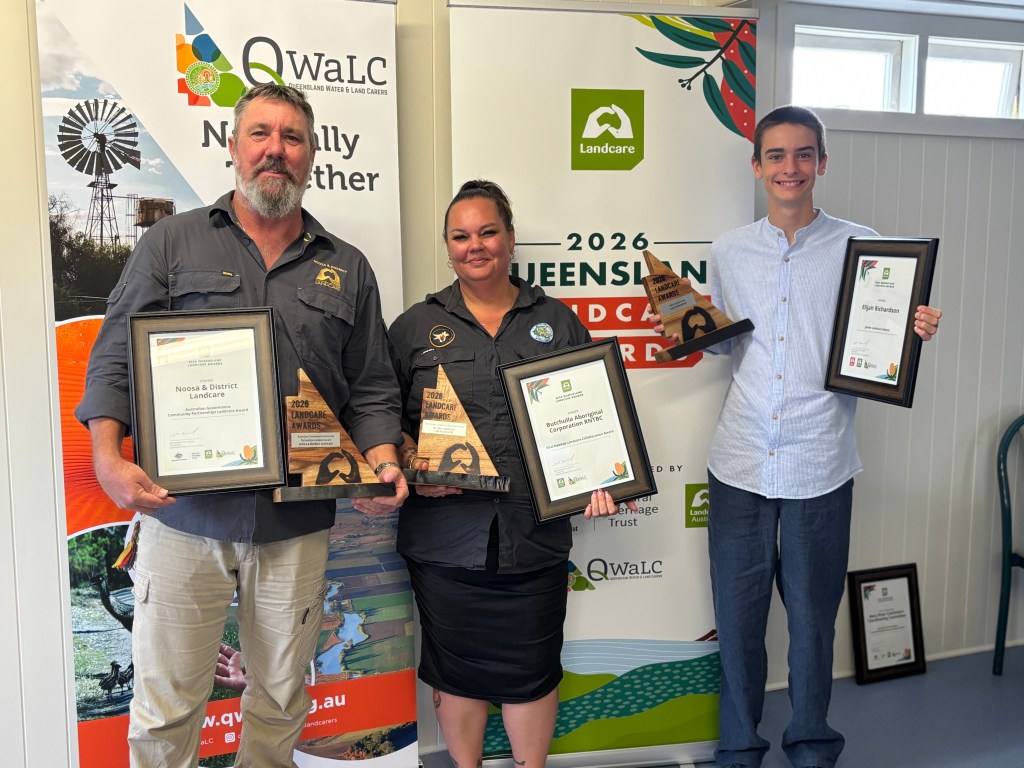
BAC was recognised for leading the development of a tenure-blind biosecurity strategy for K’gari in partnership with island stakeholders through the K’gari Biosecurity Advisory Group. The K’gari Biosecurity Strategy was developed through an 18-month project that began in late 2024, funded by an Australian Heritage Grant, and was launched earlier this year.
K’gari Biosecurity Advisory Group Chair and BAC Ranger Coordinator Chantel Van Wamelen accepted the award on behalf of BAC and its partners, alongside BAC Director Aunty Christine Royan. BAC also acknowledged the contributions of project team members Dr Geoff Pegg (DPI), Professor Jennifer Firn and Ella-Jane Raymond (Queensland University of Technology), and Sue Sargent (FINIA).
“Biosecurity is a significant issue for K’gari. More than 200 introduced species have been recorded on the island, many of them invasive pests,” Ms Van Wamelen said.
“These include cane toads, feral cats, coastal brown ants, tilapia, Jamella (pandanus leafhopper), weeds such as bitou bush and lantana, and diseases including myrtle rust and Phytophthora heveae. Bitou bush has been the focus of a concerted management program on K’gari for more than 40 years, while lantana smothers native coastal and forest vegetation.
“The strategy focuses on prevention, particularly in relation to visitors and vehicles, while maintaining surveillance so any new incursions can be reported, monitored and managed to minimise impacts on the World Heritage-listed island.
“We do not want yellow crazy ants, polyphagous shot-hole borer or Phytophthora cinnamomi to reach the island. That would be devastating for K’gari.”
Aunty Chris Royan said protecting K’gari was a shared responsibility.
“K’gari is an incredibly special place and has been sacred to us as Butchulla People for thousands of years.
“Biosecurity is everybody’s responsibility, and we need your help. If you are visiting K’gari, please check and clean your vehicle, boots and equipment before you travel—come clean and go clean.”
Queensland Landcare Award category winners automatically progress to the Australian Landcare Awards, to be held at the Adelaide Convention Centre in South Australia in September 2027.
Project partners and members of K’gari Biosecurity Advisory Group (KBAG) included Biosecurity Queensland (DPI); Butchulla Aboriginal Corporation RNTBC; Butchulla Native Title Aboriginal Corporation RNTBC; the Chief Environmental Biosecurity Office (Department of Agriculture, Forestry and Fisheries); the Department of Natural Resources (DNRMMRRD); FIDO; FINIA – the Natural Integrity Alliance for K’gari; Fraser Coast Regional Council; Horticulture and Forestry Science (DPI); K’gari Research Station (University of the Sunshine Coast); the Office of the Great Barrier Reef and World Heritage (DETSI); Queensland Parks and Wildlife Service (DETSI); Queensland University of Technology (QUT); Sealink Kingfisher Bay; and K’gari community association representatives.
Article contributed by Butchulla Aboriginal Corporation

