News

Collaboration in Action
The collaboration between the University of the Sunshine Coast and the Fraser Island Defenders Organisation (FIDO) developed further recently when FIDO made a $100,000 donation to the USC on 1 September to fund research into minimising the impact of vehicle traffic on the fragile natural environment of Fraser Island. The collaboration has grown over recent years from the USC sponsorship of the biennial Fraser Island conferences organized by FIDO and the forthcoming BioBlitz, to assisting the development of the Fraser Island Repository at Sippy Downs and other projects. (more…)

Conservation Versus Visitation
National parks were established in Queensland to protect the state’s natural heritage. This ethos continues to be at the heart of why protected area estates are established and managed around the world. For the past several decades in Australia, new areas for national parks have been identified and gazetted affording protection to threatened species and ecosystems. As the protected area estate in Queensland grows, so do the pressures and threats putting these unique areas at risk. In parallel, visitors in some parks are increasing, placing further pressure on park staff and infrastructure. This article explores why national parks are protected – for conservation or for visitors to enjoy? (more…)

Find a Frog in February!
Community assistance is needed to find out where our frogs are living from Burrum Heads south to Peregian and west to Conondale Range, Kilkivan and Mt Walsh. Frogs are a vital component of ecosystems and can be good indicators of environmental health. But they are in trouble world-wide due to habitat loss, pollution and disease and we need to know more about where they are. (more…)
Firebreak Upgrades – a Critical Interface Zone
A state-wide ‘I-zone’ initiative for the protection of ‘at risk’ private infrastructure on boundary interfaces with QPWS tenure provided funding for a review of the current firebreaks on Fraser Island (K’gari).
(more…)Fraser Island Fauna Survey
Since departing Fraser Island 16 years ago, it was great to get back there earlier this year to renew acquaintanceships with old friends and make some new ones. I was over to assist a good friend and retired herpetologist, Harald Ehmann, to look for the endangered Fraser Island endemic, the Fraser Island Sand Skink Coggeria naufragus. I was on the island from the 8-13 February this year and Harald three days longer.
Eurong Nursery Gives Bush Regeneration a Boost
FIDO’s July bush regeneration working bee planted more than 100 new native plants in the Eurong Resort grounds and village. While more than 20 of these plants came from the Kingfisher nursery on the western side of the island, the project wouldn’t have been possible without the rejuvenation of the QPWS eastern Eurong nursery. The availability of a functioning nursery to meet the demands of residents and bush regenerators has challenged FINIA since its founding in 2005.


Working with the Mob
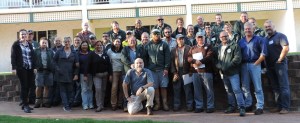
Participants of the Working with the Mob training program held in June 2016
Over two days in June, Queensland Parks and Wildlife Service (QPWS) staff and representatives of the Butchulla Traditional Owners, came together on K’gari to participate in the training program Working with the Mob.
The QPWS Partnerships Team developed the Working with the Mob training program to support its commitment to enhancing cultural competency within the agency. The time together was a great opportunity for QPWS employees to engage with the Butchulla people through an appreciation of history, tradition, culture and respect.
The training offered opportunities to break into informal groups led by Butchulla representatives. These sessions provided an excellent opportunity to learn more about the local Traditional Owners’ protocols, beliefs and values. Other training sessions included topics such as native title, indigenous cultural heritage and developing good working relationships.
Ross Belcher, Principal Ranger, Fraser Coast Area, QPWS shared some of his reflections after the training program:
“It was a pleasure to take part in this initiative on K’gari, which has made a major contribution to maintaining and building on the relationship between the Butchulla Traditional Owners and QPWS. My impression is that the Butchulla people have a strong desire to engage with the current land managers (QPWS staff) to pass on traditional values, stories and aspirations and to build a strong and respectful working relationship. The QPWS staff demonstrate a strong desire to understand the Butchulla story and to positively engage with and contribute to our cooperative relationship. We certainly have people with feet in both camps, Butchulla and other indigenous people employed by QPWS are making an outstanding contribution to K’gari, hopefully we can build the numbers up in good time. Good progress has been made in our collaboration in the management of K’gari, and I hope that in future the Butchulla people will be taking the lead in developing and coordinating more opportunities for sharing of stories and aspirations, and we will be working as one mob protecting the natural and cultural values of K’gari and surrounding Butchulla land and sea. Looking forward to the next meeting ”
Contributed by Moyra McRae, Queensland Parks and Wildlife Service, Maryborough
BioBlitz Bonus!
The BioBlitz has attracted interest from an unexpected quarter. The Fraser Coast RATs (Regional Artists and Tutors) are are keen to cover the BioBlitz as a community-based arts projects, A representative of the group describes their plans: “Members of this award winning contemporary artists group have multi discipline art practices and a common goal to engage the public with regionally based arts projects. We work closely with Fraser Coast community organisations on projects as diverse as ‘Art in empty shopfronts’ to community Street Art commissioned by Fraser Coast Council.”
Fraser Island to be BioBlitzed by Scientists
Led by FIDO, a huge Fraser Island (K’Gari) BioBlitz from 28 November to 4 December will bring together experts from many areas of biology to carry out a stocktake of the natural resources of the World Heritage island.
Based at the Dilli Village Fraser Island Research and Learning Centre, the BioBlitz is being well supported by the University of the Sunshine Coast, the Queensland Parks and Wildlife Service and FINIA.
The study area extends from the ocean beach to Lake Birrabeen, covering all six dune systems and encompassing most ecosystem types from heathlands, tall forests, swamps, fens and perched dune lakes except for the estuarine environments. It is hoped to achieve more by maintaining a tight and intense focus on this particular study area rather than an island wide hunt.
The study area is very accessible with a number of tracks through it that will allow scientists to easily access representative places of interest.
Celebrating Ten Years of FINIA on film!
After our tenth anniversary meeting held on Fraser Island (K’Gari) in December, a short digital story was produced to promote and highlight the achievements of FINIA over the years and its importance in tackling environmental issues on the island.
 FINIA
FINIA 