News
New Biosecurity Act
As of 1 July, a new Biosecurity Act now encompasses the previous Land Protection Act. Focused on risk-based management and on the likelihood and consequences of the risk of spread, this broader Act will continue the management of invasive plants and animals throughout Queensland. All Queenslanders, individuals and organisations have a general biosecurity obligation to take reasonable steps to report and ensure they do not spread a pest, disease or contaminants. (more…)
Fraser Island WHA Indigenous Advisory Committee FINALIST in National Landcare Awards!

Vote now for the People’s Choice Awards
The Recognising & Recording K’Gari’s (Fraser Island) Cultural Heritage project was initiated by the Fraser Island World Heritage Area Indigenous Advisory Committee in 2012 and was delivered by the Butchulla people and Aboriginal Rangers of Fraser Island.
Through strong partnerships, the project provided training to the Butchulla community, leading to additional cultural heritage sites being located including the highly significant Bogimbah Mission grave sites on this World Heritage listed property. The project has established closer ties between the Aboriginal Ranger team and Butchulla elders and broader engagement and stewardship by the Butchulla community with forums, field trips and newsletters.
Judging is currently underway with the announcements to be made at the National Landcare Conference and Gala Awards being held in Melbourne in September. You can also vote for the Indigenous Advisory Committee in the People’s Choice Awards, just click on the icon.
Note: Although you are able to vote in every category, you don’t have to, so just look for the group in the Indigenous Land Corporation Indigenous Landcare Category.

National Standards for Ecological Restoration
The National Standards for the Practice of Ecological Restoration in Australia have just been released by the Society for Ecological Restoration in Australia (SERA) board’s Principles and Standards Reference group in close collaboration with partners and advisors.
(more…)
Sustainable Transport Study for Fraser Island (K’Gari)
For almost a year, FIDO and QPWS were at an impasse over FIDO’s proposal to fund a feasibility study into the building of a light rail from Kingfisher Resort to Eurong. The QPWS saw four major impediments to them supporting such a study, while FIDO remained alarmed at the down-cutting of the fragile sand roads, with the scoured out sediment ending up in other locations.
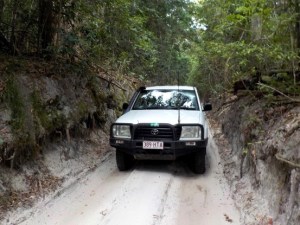
Down-cutting along 0.5 km of Woralie Track between the eastern edge of the rainforest and the turnoff to Lake Allom has carved a canyon 2 m deep. Thousands of tonnes of sand have been relocated downslope from these cuttings
FIDO estimates that, on average, every visitor to Fraser Island travelling by any form of 4WD (including buses) is responsible for stirring up more than a tonne of sand that will be scoured downslope when it rains. Some of this ends up in Fraser Island’s precious lakes. FIDO has long been calling for a stop to the unnecessary stirring up of surface sand and, for 42 years, has been advocating a light rail alternative to 4WDs.
A meeting with Environment Minister Steven Miles on 11 April helped to resolve the stalemate between FIDO and QPWS. It was resolved that the environmental impact of road down-cutting on K’gari needs to be urgently addressed. The agreed outcome was that FIDO will commission and pay for an independent ‘Sustainable Transport Options for Fraser Island (K’Gari)’ study. This study will explore all options, including light rail, to reduce the current environmental impact of visitation.
In 2002, a study by Gutteridge Haskins & Davey Pty Ltd (GHD) on K’Gari found:
- Moderate severity smothering: 6% of road network
- Moderate down-cutting: 7% of road network
- High-severity siltation: 8 sites
- Cultural heritage site: 1 site impacted by roads
- High-severity smothering: 1% of road network
- Severe down-cutting: 2% of road network
- Moderate severity siltation: 12 sites
Using money from the Barbara Winkley bequest that FIDO anticipates to receive in the near future, FIDO will seek to revive the GHD study commissioned in 2000 by the QPWS that was halted prematurely in 2002 just as it was nearing a critical conclusion. The now proposed study will, among other things, update the 2002 information to determine how the state of K’Gari’s roads has changed in 15 years.
John Sinclair (AO), FIDO
New Research Alert!
Several papers were published recently (2016) that may be of interest to FINIA readers including a review of coastal dunefield evolution in SEQ, Ground Penetrating Radar observations in the Great Sandy National Park (including Moon Point),patterns of phylogenetic diversity in subtropical rainforests, and the diet and body condition of Fraser Island dingoes. Details and links are provided below. (more…)
Weed of the Month – Easter Cassia
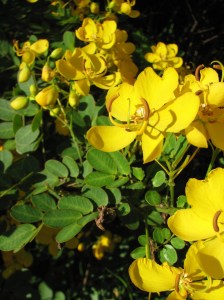
Flowing Easter Cassia
Easter cassia, Senna pendula var. glabrata, is native to South America. The shrubs are easy to spot this time of year as they are in flower. This weed is not classified under the Land Protection (Pest and Stock Route Management) Act 2002; however, it is classified as an environmental weed by the Fraser Coast Regional Council.
It is a successful invader to disturbed sites. Its main distribution on Fraser Island is at Eurong and Happy Valley, with small patches found at Indian Head, Orchid Beach, Sandy Cape and Moon Point. Easter cassia is controlled both chemically and physically. Methods include stump cutting, foliar spray, basal bark spraying and hand pulling small plants. There is no known biological control, but Easter cassia is intolerant of fires. For further information, go to: www.frasercoast.qld.gov.au.
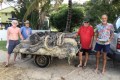
Fighting Triffids
Peter Shooter continues to lead his teams of FIDO volunteers in their never-ending war against the very aggressive and invasive African subspecies of Abrus prectorius.
(more…)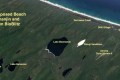
A BioBlitz for Fraser Island
A BioBlitz on Fraser Island (K’gari) has moved a few steps closer to reality with FIDO setting the proposed dates for the Blitz as 28 November – 4 December 2016. However, before FIDO can launch the promotion for the BioBlitz, which is supported by FINIA, the University of the Sunshine Coast (USC) and the Queensland Parks and Wildlife Service, supplementary funding is required to engage a coordinator to liaise with scientists and other participants and retrieve the vital data collected. At this stage, FIDO is only issuing advance warning to alert people to the proposed BioBlitz event: Beach to Boomanjin and Birrabeen.
Details of Beach to Boomanjin and Birrabeen
Fraser Island (K’Gari) is inscribed on the World Heritage list because of its biological, geomorphological and aesthetic values; however, much more biological research is needed to know the extent of K’gari’s natural resources, with a BioBlitz of a discrete part of Fraser Island standing to add greatly to the ecological understanding of this site.
The BioBlitz, which is to be based at Dilli Village, aims to bring together teams of entomologists, botanists, ornithologists, zoologists, herpetologists and other specialist groups (fishes, fungi, etc.) to scour the study area. Each team will develop its own program and modus operandi. It is expected that the team leader will be responsible for compiling a report of the team’s findings to add to the existing data banks being built at USC.
FIDO is seeking to appoint a coordinator before this project can proceed. The coordinator will recruit specialist scientists from a range of disciplines to study the defined research area, which covers a diversity of habitats, to develop an inventory of the natural resources and species within that area. FIDO will also recruit volunteers as necessary to assist scientists and specialists logistically.
The study area includes samples of all six dune systems, including Dune System 4 east of Lake Birrabeen and Dune Systems 5 and 6 in the vicinity of the Boomanjin airstrip. In addition, the area includes three large perched dune lakes, two creeks and a number of old swamps, as well as various forest types. It will be a broad transect of a wide range of ecotypes, from the beach through the foredunes and the freshwater aquatic environments of Govi and Gerrawea Creeks. It will also enable comparison between mined and unmined areas in both the foredune and hind dune areas. It will include the large peat swamp, with its flarks and fens, never before studied in detail.
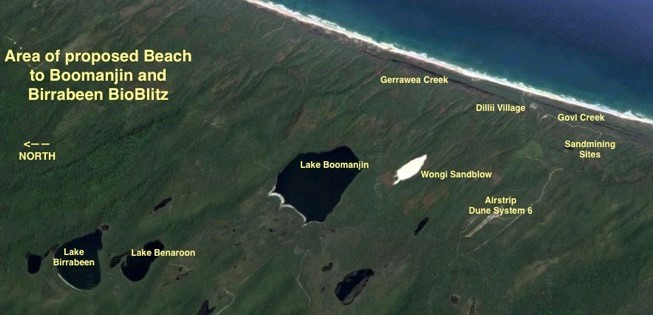
The proposed study area will include a diverse range of ecotypes, including all 6 dune system types
Dilli Village has accommodation for up to 60 people, as well as a large camping area and 24-hour 240V power, which may be needed for some equipment. It also has a large meeting area. There will be opportunities at Dilli Village each night for the various teams to compare notes and share observations of their field work.
John Sinclair (AO), FIDO

Green Army Battles for K’Gari’s Natural Integrity
Work is underway in Fraser Island World Heritage area by the first 9-person Green Army team, which includes three young Butchulla men. Despite encountering hold-ups in gaining approval for overnight residence on the island, as well as delays in beginning training, the Green Army team is being kept busy with the important tasks of removing rubbish, lantana, groundsel and other weeds from the main entry road near the Wanggoolba ferry landing, and lantana control in Dundubara creek.
As they return each week as part of their six-month program, every member of the team is gaining a greater familiarity with Fraser Island (K’gari) and personally benefitting from the training and experience they are receiving. As part of their work, the Green Army team has received training in safe chemical use, as well as fencing construction and deconstruction. They have been using these new skills to contribute to K’gari’s natural integrity.
It is hoped that as the program progresses, the productivity of future teams will benefit from overcoming the challenges that any new partnership arrangement must face (especially for an area as significant as the Fraser Island World Heritage Area). In this way, we hope that the CVA Green Army teams will be an ongoing presence on Fraser Island and will be able to make an even greater contribution to weed and erosion control in some very critical areas of K’Gari.

Work Continues on George Haddock Track
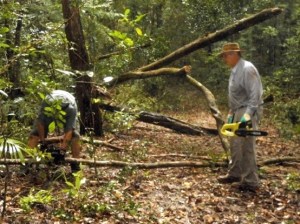
Track clearing was done manually, with little assistance other than from battery-operated chainsaws to deal with larger tree-falls across the track
Over the 2016 Easter weekend, 16 volunteers helped to honour FIDO’s obligation to maintain the George Haddock Track. The team cleared 17 km of track of fallen timber and major regrowth. During 2014, FIDO and National Parks Association of Queensland volunteers cleared 22.7 km of walking tracks along former logging tracks and roads in nine different sections of the 52 km George Haddock Track, supported by a Friends of Parks grant. No maintenance had been done since October 2013, except for a little clearing between Lake Coomboo and Hidden Lake.
During these latest clearing efforts, the swathe of cleared ground around the Harold Charles Barracks was greatly extended by stripping away regrowth and accumulated fallen debris. This will provide critical infrastructure with a greater safety margin from potential fires. It also created a larger flat area for campers participating in future working bees.
John Sinclair (AO), FIDO
 FINIA
FINIA 